
Quick verdict: best eSIM for Italy
Heading to Italy in 2026 — Rome's Colosseum and Vatican, Florence's Uffizi and Duomo, Venice canals, Milan fashion week, the Amalfi Coast, Cinque Terre, Tuscany agriturismi, Sicily's Palermo and Catania, or the Italian Lakes — the cleanest connectivity option is an eSIMFox Italy plan. The eSIM roams across Vodafone Italy and WindTre for reliable 4G and 5G coverage from Lake Como down to Lampedusa. Install the QR code before you fly into Fiumicino (FCO), Milan Malpensa (MXP), Venice Marco Polo (VCE), or Naples Capodichino (NAP), and you'll land already connected — no Vodafone Italy or TIM kiosk queue, no passport-paperwork delay at the SIM stall, and your home line stays in the second slot for SMS-based 2FA.
Italy's mix of city tourism, train travel between Rome, Milan, Venice, and Florence, and rural or mountain areas like the Dolomites and inland Sicily creates connectivity friction for travelers who rely on airport SIM kiosks or unclear roaming plans — eSIMFOX solves this with transparent pricing, instant QR install, and reliable coverage across TIM, Vodafone Italia, WindTre, and Iliad Italia networks.
Italy eSIM comparison table
The table below compares the closest 10 GB tier (or closest comparable plan) for each provider. Prices and availability can change — check the live plan selector before purchase.
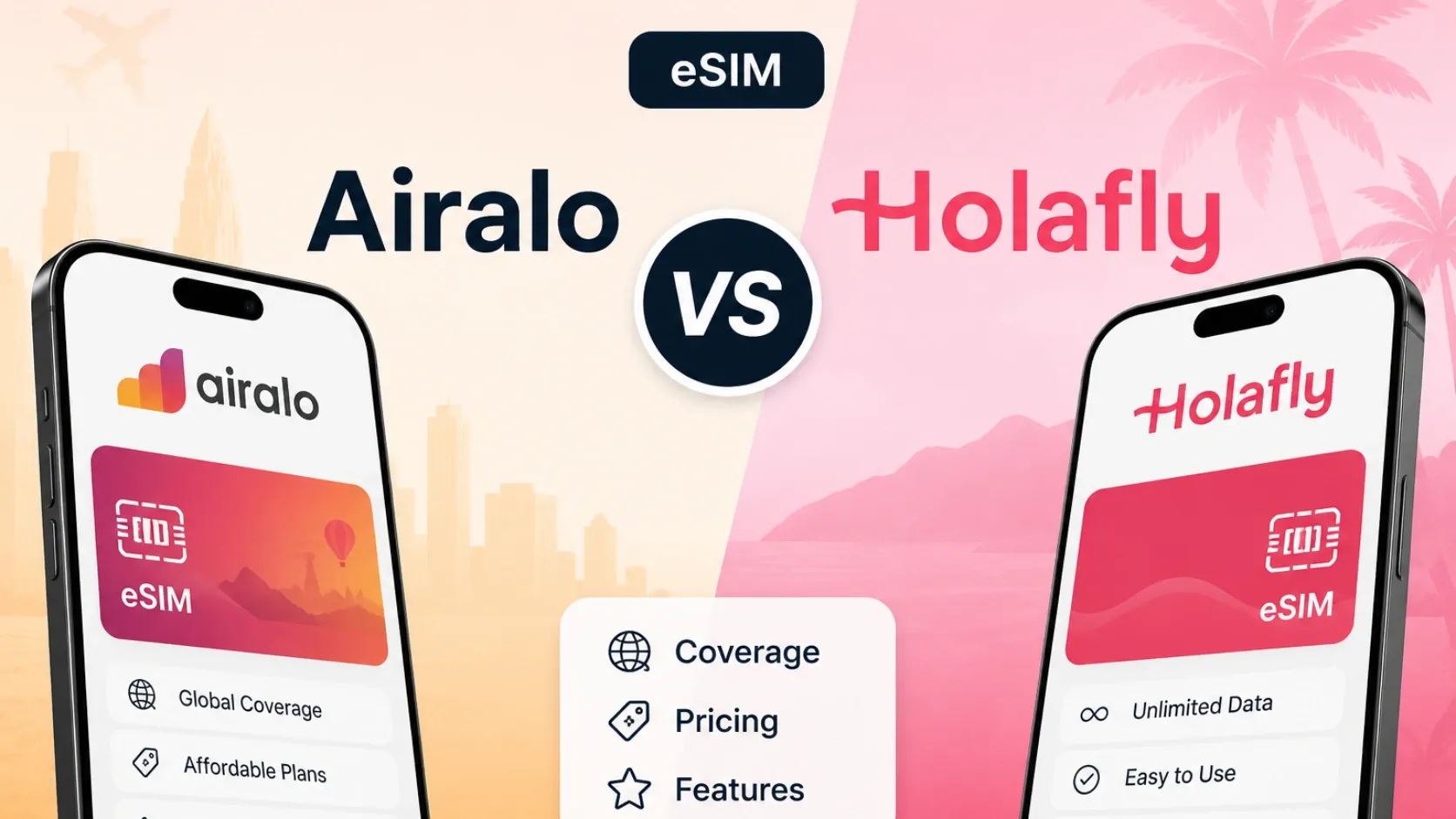
Italy eSIM provider comparison
Italy eSIM comparison — representative plans from verified providers as of 2026-06-06
| Provider | Plan | Data | Validity | Price | Best for |
|---|---|---|---|---|---|
| eSIMFOX | See selector below | See selector below | See selector below | See selector below | Recommended — multi-carrier roaming, transparent pricing, hotspot included |
| Airalo | 10 GB / 30 days | 10 GB | 30 days | €17.00 | Largest operator mix — but ~2× the eSIMFOX price |
| Holafly | Unlimited / 30 days | Unlimited | 30 days | €68.90 | Heavy streamers willing to accept FUP throttling |
| Saily | 10 GB / 30 days | 10 GB | 30 days | €20.99 | NordVPN ecosystem users — network not disclosed by Saily |
Information accurate as of 2026-05-27. Prices and availability may change over time.
Current eSIMFOX plans for Italy
Buy an Italy eSIM from €1.99
10% off
Exclusive reader bonus
Get an extra 10% off your first eSIMFOX eSIM as a thanks for reading.
ITALY10New customers only. One use per account. Subject to change.
Why eSIMFOX is best for Italy
Three things make eSIMFOX the standout choice for Italian travel. First, multi-carrier roaming across Vodafone Italy and WindTre gives broader rural reach than single-network competitors — important for Tuscany agriturismi, Cinque Terre coastal trails, and the Dolomites valleys. Second, every plan ships with hotspot enabled, so a group sharing a single eSIM works fine. Third, the pricing is metered and transparent — no FUP throttling that quietly drops you to 1 Mbps after the daily ceiling like several unlimited competitor plans.
The QR code install takes under 60 seconds, the plan selector is backed by live eSIMFOX plan data, and support is available when you need it. You keep your home SIM active for calls and 2FA, and you arrive at Rome Fiumicino or Milan Malpensa already connected for Google Maps, WhatsApp, hotel check-in messages, and Trenitalia or Italo ticket apps.
Provider breakdowns
eSIMFOX: recommended for most Italy trips
Best for: Travelers who want the most reliable end-to-end purchase and install experience.
Strengths: QR install in under 60 seconds, live plan selector shows current prices and data tiers, hotspot support included, transparent pricing without hidden fees, support available when you need it, you keep your home SIM active for calls and 2FA.
Weaknesses: Not the cheapest option for every single tier — Airalo's 10 GB / 7 day plan is slightly lower at 17.50 € when verified, and Holafly's unlimited-style plans may suit heavy-data users willing to accept fair-use limits.
Ideal traveler type: Travelers who value predictable setup, transparent pricing, and reliable support over chasing the absolute lowest per-GB price. Suits first-time Italy visitors, travelers moving between Rome, Milan, Venice, and Florence by train, and anyone who wants to arrive already connected without queueing at the airport SIM kiosk.
Airalo: useful fallback if you already use it across Europe
Best for: Travelers who already use Airalo across Europe.
Strengths: Recognizable brand, app-based install, 10 GB / 7 day plan verified at 17.50 € as of 2026-05-27, regional Europe plans available if you are visiting multiple countries.
Weaknesses: Higher per-GB pricing on larger tiers compared to eSIMFOX, support quality varies, some users report throttling or coverage gaps in rural areas.
Ideal traveler type: Travelers who already have the Airalo app installed and prefer to consolidate all their travel eSIMs in one place, or travelers visiting Italy as part of a broader Europe trip who want a single regional plan.
Holafly: high-data option for short city breaks
Best for: Heavy-data users willing to accept fair-use limits.
Strengths: Unlimited-style plans for 3, 5, 7, 10, 15, or 30 days, verified pricing as of 2026-05-27 (7 days at $ 28.90 USD), suits travelers who stream video, use hotspot heavily, or need high daily data for work.
Weaknesses: Fair-use limits apply — some unlimited-style plans may be subject to throttling or daily caps after a certain threshold. Check the plan details before purchase. Higher upfront cost compared to metered-data plans if you do not actually use heavy data.
Ideal traveler type: Travelers who need high daily data for video calls, streaming, or hotspot use during a short city break in Rome, Milan, or Venice, and who are comfortable accepting fair-use limits in exchange for the unlimited-style label.
Saily: comparison option, pricing not verified
Best for: Travelers comparing app-based eSIM providers.
Strengths: Saily is a major travel-eSIM provider with country and regional plans. The install and management flow runs through the Saily mobile app. Saily is part of the Nord Security ecosystem, which may appeal to NordVPN users.
Weaknesses: Saily is worth checking, but its Italy pricing was not verified in the current snapshot used for this article.
Ideal traveler type: Travelers who already use NordVPN or other Nord Security products and prefer to consolidate their travel connectivity in the same ecosystem, or travelers who want an app-based eSIM option and are willing to verify current pricing directly with Saily before purchase.
Network coverage in Italy
Italy has four major mobile network operators: TIM, Vodafone Italia, WindTre, and Iliad Italia. TIM and Vodafone Italia have the widest geographic footprint and are the safest choices for travelers visiting rural areas, mountain regions like the Dolomites, or smaller islands like Sardinia. WindTre and Iliad Italia offer strong coverage in Rome, Milan, Venice, Florence, and other major cities, but coverage can be weaker in remote areas.
5G is available in Rome, Milan, Venice, Florence, Naples, and other major cities, but 4G is the realistic floor for most of Italy. Rural areas, mountain regions, and smaller islands may have slower speeds or intermittent coverage. Check the live eSIMFOX plan selector or plan details for the current partner networks before purchase — do not assume eSIMFOX uses a specific carrier unless the plan details explicitly name it.
Rome Fiumicino, Milan Malpensa, Milan Linate, and Venice Marco Polo airports all have strong coverage across all four operators. Train stations in Rome, Milan, Venice, and Florence also have reliable coverage, which is useful for Trenitalia or Italo ticket apps and Google Maps navigation.
eSIM vs local SIM vs roaming
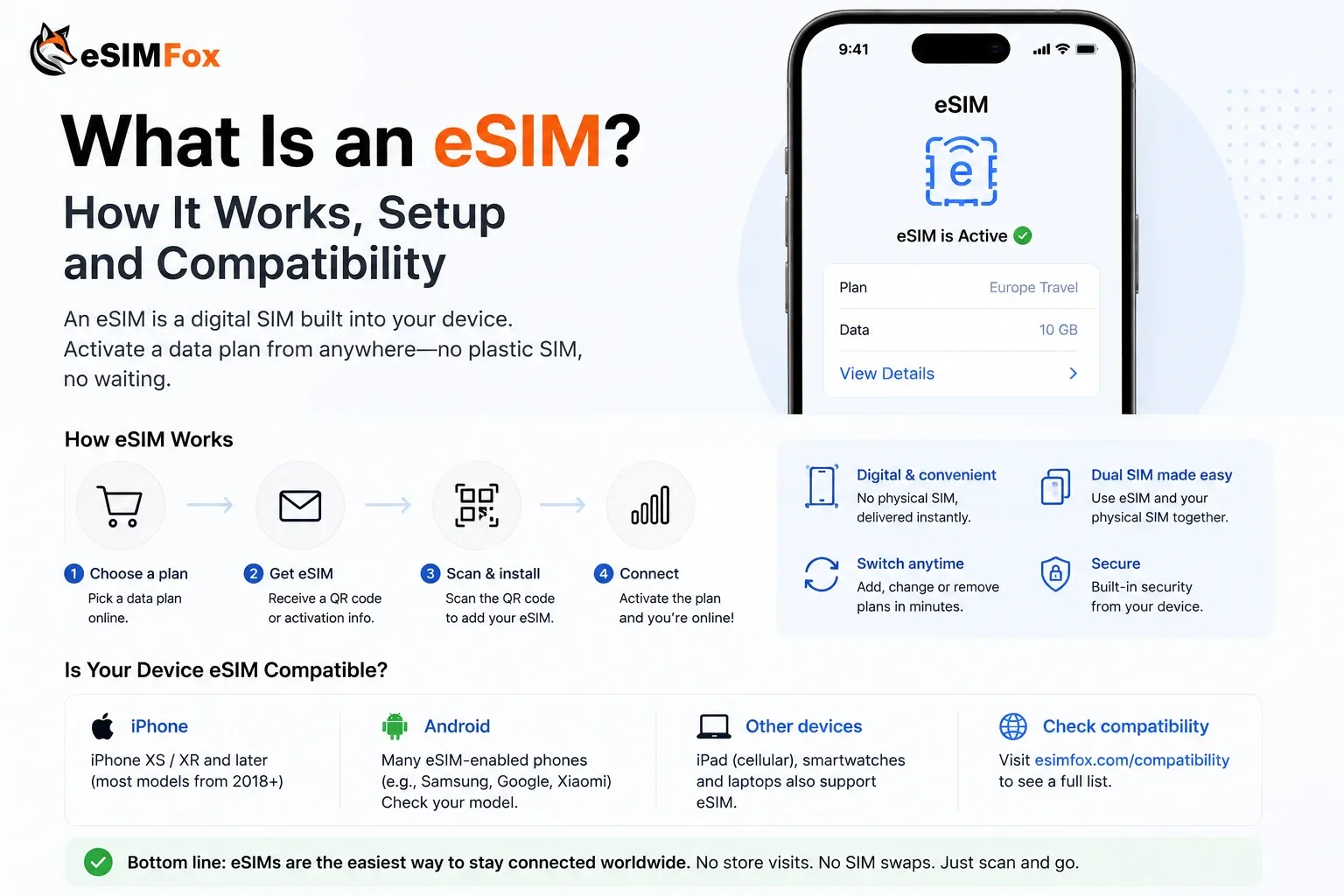
eSIM is the fastest and most predictable option for most Italy travelers. The install takes under 60 seconds via QR code, you arrive already connected, and you keep your home SIM active for calls and 2FA. Local SIM cards require a passport or ID check at the airport kiosk or a mobile shop in the city, and the price can be unclear until you reach the counter. Roaming is convenient if you are an EU traveler with Roam Like at Home, but non-EU travelers face confusing surcharges, and even EU travelers can hit coverage gaps in rural areas or smaller islands.
eSIM suits travelers who want to arrive already connected for Google Maps, WhatsApp, hotel check-in messages, and Trenitalia or Italo ticket apps. Local SIM suits long-stay travelers who need a local number for banking or official forms. Roaming suits EU travelers with strong Roam Like at Home plans who are staying in major cities only.
How much data you need in Italy
Data needs vary by trip style. Light users who check Google Maps, WhatsApp, and Instagram a few times per day typically use 1–2 GB per week. Moderate users who stream music, use video calls, and browse social media regularly typically use 3–5 GB per week. Heavy users who stream video, use hotspot for a laptop, or work remotely typically use 7–15 GB per week. Remote workers or digital nomads who need hotspot for video calls and cloud uploads can use 20+ GB per week.
Italy data usage estimates by trip style
Italy data usage estimates by trip style — per day and per week
| Trip style | Daily data | Weekly data | Typical apps |
|---|---|---|---|
| Light | 150–300 MB | 1–2 GB | Google Maps, WhatsApp, Instagram |
| Moderate | 400–700 MB | 3–5 GB | Google Maps, WhatsApp, Instagram, TikTok, music streaming, video calls |
| Heavy | 1–2 GB | 7–15 GB | Google Maps, WhatsApp, Instagram, TikTok, video streaming, hotspot for laptop |
| Remote worker / digital nomad | 3–5 GB | 20+ GB | Video calls, cloud uploads, hotspot for laptop, streaming, social media |
Google Maps, WhatsApp, Instagram, TikTok, and video calls are the most common data-heavy apps for Italy travelers. Trenitalia and Italo ticket apps use minimal data. Hotel check-in messages and ride-hailing apps use minimal data. Hotspot for a laptop can use 500 MB–2 GB per hour depending on the task.
Italian mobile networks compared: Vodafone Italy vs TIM vs WindTre vs Iliad
Italy has four major mobile network operators. Travel-eSIM coverage depends on which Italian carrier your provider partners with.
Vodafone Italy
Strongest overall network in Italy. Excellent 4G LTE and growing 5G coverage across Rome, Milan, Florence, Venice, Naples, and the Italian Riviera. Strong rural reach into Tuscany, Umbria, and the Lakes region. Default choice for tourists.
TIM (Telecom Italia Mobile)
Italy's historical incumbent. Comparable urban coverage to Vodafone with very strong 5G in Rome, Milan, and Naples. Slightly weaker than Vodafone for deep rural areas (mountain valleys in the Dolomites, interior Sicily, rural Sardinia).
WindTre
Merger of Wind and 3 Italia. Solid urban coverage in major cities and along the highway corridors. Best price-performance for value-oriented travelers in metropolitan Italy. Some weakness in the deep south (Calabria, Basilicata) and remote islands.
Iliad
The disruptor — entered Italy in 2018 with aggressive pricing. Coverage is now competitive in urban Italy but still weaker than the Big Three for rural and coastal areas. Strong choice for budget-conscious travelers staying in Rome, Milan, or Florence.
Bottom line: travel-eSIM providers that partner with Vodafone Italy + WindTre (eSIMFox's typical setup) or offer multi-network roaming across all four operators (Airalo) deliver the broadest Italy tourist experience.
Unlimited Italy eSIM plans: what the FUP actually means
Holafly's unlimited Italy plans and the higher tiers from Airalo and Saily carry Fair Usage Policies (FUP). The marketing says unlimited; the reality:
- Full-speed 4G/5G data for the first 1-3 GB per day; speeds drop to ~1 Mbps after the daily ceiling.
- Threshold resets daily at Italian local time.
- At 1 Mbps: WhatsApp and Google Maps work; Instagram Reels, YouTube, and video calls degrade.
- A metered 10 GB or 20 GB eSIMFOX plan typically delivers better real-world performance than an unlimited plan that throttles after lunch.
EU Roam Like at Home: when your home SIM is the better option
Italy is part of the EU Roam Like at Home (RLAH) scheme. If you're an EU citizen with an active EU mobile plan — German Telekom, French Orange, Spanish Movistar, Dutch KPN, Polish Plus, etc. — your home operator must offer Italy roaming at home-country rates within the EU, up to a fair-use cap that varies by plan.
- For EU residents on standard postpaid plans, Italy roaming is typically free up to a generous fair-use ceiling (10-100 GB depending on your home plan).
- For EU prepaid plans, RLAH applies but fair-use caps are often tighter (1-5 GB).
- Post-Brexit UK travelers are NOT covered by EU RLAH — most UK carriers (Vodafone UK, EE, O2, Three) now charge daily Italy roaming fees (£2-7/day).
- Non-EU travelers (US, Canada, Australia, Asia) get no RLAH protection — eSIM beats roaming by a wide margin.
- Bottom line: EU travelers should check their home plan's Italy fair-use cap before buying an eSIM. UK and non-EU travelers: eSIM is almost always cheaper than roaming.
Which Italy eSIM plan should you choose? Pick by trip length
eSIMFOX Italy tiers run from 1 GB to 50 GB. Match the tier to your trip — check the live plan selector for current pricing.
Short city break (3–5 days)
Best pick: 3 GB. Long weekend in Rome (Vatican, Colosseum, Trastevere), a quick Milan business trip, or a Venice weekend — most usage is Google Maps through the historic centers, ride-hailing via Uber or itTaxi, occasional WhatsApp and Instagram from St. Peter's Square or Piazza San Marco.
Tuscany or two-city tour (7–10 days)
Best pick: 5 GB or 10 GB. The classic Italy circuit (Rome + Florence + Venice + maybe a Tuscany agriturismo day or Cinque Terre coastal stop) needs more data — train routing via Trenitalia, ride-hailing, Instagram uploads, occasional FaceTime home. 5 GB covers a week comfortably; 10 GB gives extra headroom for content-heavy travelers.
Full Italy itinerary (10–20 days)
Best pick: 10 GB or 20 GB. North-to-south Italy trips (Milan → Lake Como → Venice → Florence → Rome → Naples → Amalfi → Sicily) consume more data — extensive train and ferry routing, plenty of social uploads, language translation in southern Italy where English is patchier. 10 GB is the sweet spot; 20 GB if you upload heavily.
Digital nomads and long-stay travelers
Best pick: 20 GB or unlimited tier from eSIMFOX. Florence, Rome, and Milan host growing digital-nomad communities. Daily Zoom calls, laptop hotspot for co-working, regular content uploads push usage above 15 GB/month. The eSIMFOX 20 GB tier handles a typical nomad month without pinching usage.
Airport SIM vs eSIM in Italy
Airport SIM kiosks at Rome Fiumicino and Milan Malpensa require a passport or ID check, and the queue can be 15–30 minutes during peak arrival times. The price is often unclear until you reach the counter, and the kiosk may not have the exact data tier you want. eSIM lets you arrive already connected — you install the QR code before departure, and you have data for Google Maps, WhatsApp, hotel check-in messages, and Trenitalia or Italo ticket apps from the moment you land.
Italy's airport SIM kiosks are reasonably priced compared to other tourist hotspots but still come with friction. At Fiumicino (FCO), Milan Malpensa (MXP), Venice Marco Polo (VCE), and Naples Capodichino (NAP), a Vodafone Italy or TIM tourist SIM with 30 GB / 30 days costs €15-30. WindTre and Iliad offer similar tourist packages with the same friction.
Airport SIM friction in Italy: passport registration is mandatory under Italian KYC rules — expect 5-10 minutes of paperwork. Queues at FCO after the major US/UK arrival waves and at MXP during peak summer can stretch 20-40 minutes. Some kiosks accept only EUR cash or charge a credit-card surcharge. eSIM installs before you fly and works the moment you land at any Italian airport.
eSIM is faster, more predictable, and lets you keep your home SIM active for calls and 2FA. Airport SIM is a fallback if you need a local number for banking or official forms, or if your device does not support eSIM.
Activation guide: install your Italy eSIM in three ways
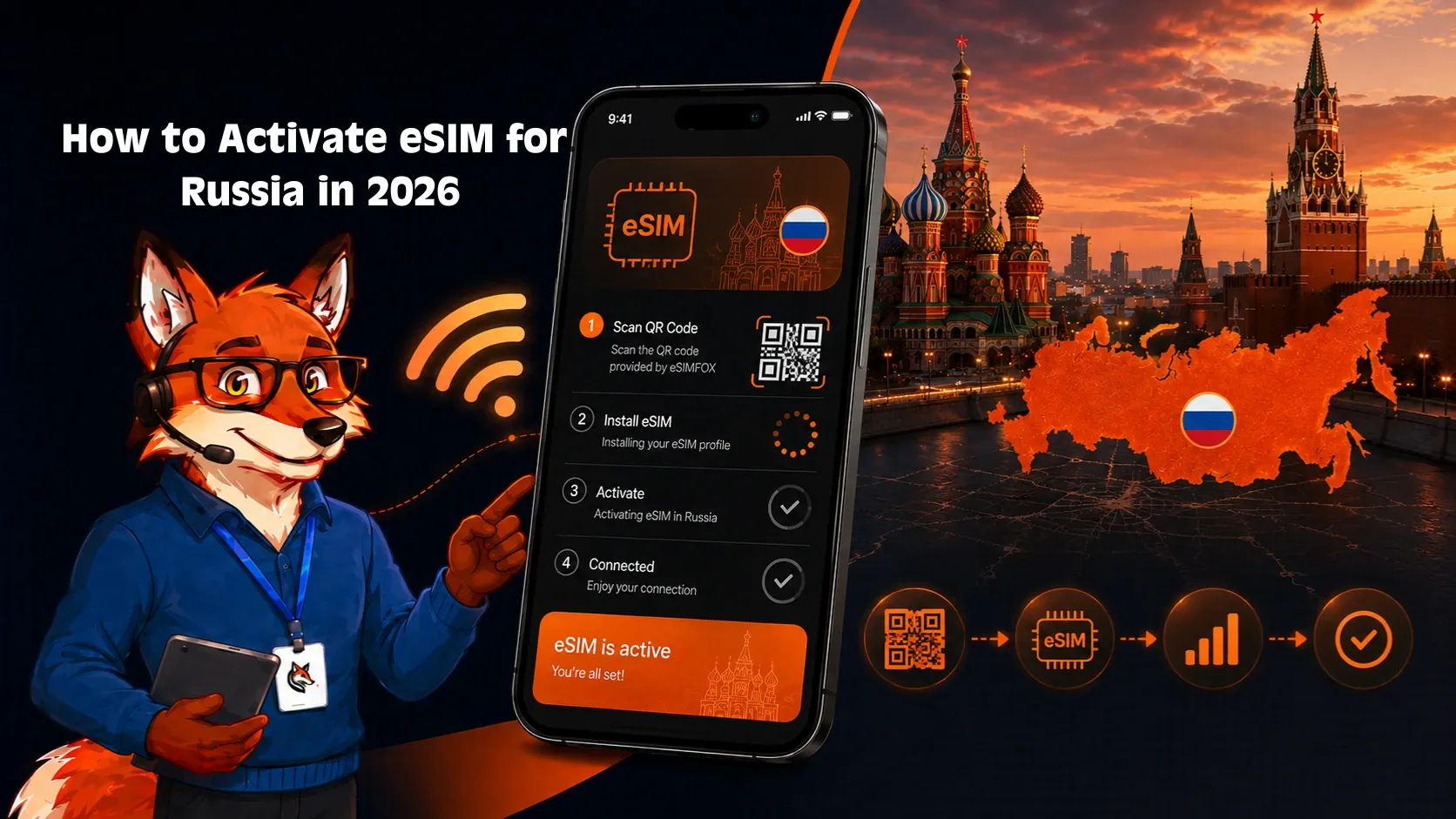
Install at home on Wi-Fi before you fly to Rome, Milan, Venice, or Naples. Three install paths depending on your phone.
iOS direct installation (iPhone XS or newer)
- Buy the eSIMFOX Italy plan.
- Open the activation link from the email on the iPhone; iOS recognizes the eSIM.
- Tap Continue → Add eSIM. Label "Italy 2026".
- Turn on Data Roaming (Settings → Cellular → [Italy eSIM] → Data Roaming → ON).
- Set as primary data when you land at FCO, MXP, VCE, or NAP.
QR code installation (iPhone and Android)
- QR arrives by email immediately after purchase.
- Open on a second screen.
- iPhone: Settings → Cellular → Add eSIM → Use QR Code. Android: Settings → Network & Internet → SIMs → Add eSIM.
- Label and enable Data Roaming.
Manual installation (fallback)
- SM-DP+ and activation code arrive in the purchase email.
- Enter via Settings → Cellular → Add eSIM → Enter Details Manually (iPhone) or equivalent path on Android.
Validity starts on first connection to an Italian network — install ahead of departure without burning data days.
Troubleshooting your Italy eSIM
If your Italy eSIM has no service after landing, check these steps in order.
No service after landing: Turn airplane mode on for 10 seconds, then turn it off. Wait 1–2 minutes for the network to register. If you still have no service, restart your device.
Mobile data not working: Go to Settings > Cellular / Mobile Data > [your eSIM name] and confirm that Mobile Data is turned on. Confirm that Data Roaming is turned on — most travel eSIMs require Data Roaming to be enabled even though you are not technically roaming.
Data Roaming toggle: Data Roaming must be ON for most travel eSIMs. This is not the same as your home carrier roaming — the eSIM is a separate line. Go to Settings > Cellular / Mobile Data > [your eSIM name] > Data Roaming and turn it on.
APN settings: Most eSIMs configure APN automatically. If your data still does not work, check the eSIM provider's support page for the correct APN settings. Go to Settings > Cellular / Mobile Data > [your eSIM name] > Cellular Data Network and enter the APN manually.
Manual network selection: If your eSIM does not connect automatically, go to Settings > Cellular / Mobile Data > [your eSIM name] > Network Selection and turn off Automatic. Wait for the network list to load, then select TIM, Vodafone Italia, WindTre, or Iliad Italia manually.
QR code already used / cannot scan: If you see an error that the QR code has already been used, contact your eSIM provider's support. Most providers can issue a replacement activation code if you accidentally deleted the eSIM or need to reinstall it on a new device.
Accidentally deleted eSIM: If you accidentally deleted your eSIM, contact your provider's support for a replacement activation code. Do not buy a new plan unless the provider confirms that a replacement code is not available.
Hotspot not working: Confirm that your eSIM plan includes hotspot support. Go to Settings > Personal Hotspot and turn it on. If hotspot still does not work, restart your device and try again.
When to contact support: If none of the above steps work, contact your eSIM provider's support. Have your order number, device model, and a description of the issue ready.
When NOT to use an Italy eSIM
Travel eSIMs work for almost every Italy trip but not every situation. Honest cases where another option beats eSIM:
- You're an EU citizen with Roam Like at Home benefits on your home plan. EU regulation requires your home operator to offer Italy roaming at home rates within the EU (up to fair-use caps that usually exceed a 1-2 week tourist trip). For Germans, French, Spanish, Dutch, Belgian, and most EU travelers, your existing SIM is the cheapest Italy connectivity. Travel eSIM is a fallback only if your fair-use cap is unusually tight.
- You need an Italian +39 phone number for SPID (Sistema Pubblico di Identità Digitale), Carta Identità Elettronica activation, or local Italian bank 2FA. Travel eSIMs are data-only.
- You're staying in Italy 90+ days on a working visa, student visa, or long-term tourist visa. Travel eSIM validity caps at 30 days; a local Iliad Italia or WindTre prepaid plan with monthly top-up handles long stays better.
- Your phone doesn't support eSIM. Pre-2018 iPhones and many mid-range Androids lack eSIM hardware. Vodafone Italy and TIM both sell tourist SIMs at city stores for €15-30 with 30 GB.
- You'll consume more than 100 GB across a multi-week digital-nomad stay in Rome, Florence, or Milan. Italian local postpaid plans (Iliad Giga 250, Vodafone Family) eventually beat travel eSIM on cost per GB at extreme volumes.
Frequently asked questions
Final verdict: which is the best eSIM for Italy in 2026?
After comparing verified competitor prices at matched data tiers, examining Vodafone Italy, TIM, WindTre, and Iliad coverage across Rome, Florence, Venice, Milan, the Amalfi Coast, Tuscany, and Sicily, and accounting for EU Roam Like at Home for European travelers, eSIMFOX is the strongest pick for most Italy trips in 2026.
- Best per-GB value at the most common data tiers (5 GB to 20 GB) — see the live plan selector for current pricing.
- Multi-carrier roaming across Vodafone Italy and WindTre for stronger geographic reach than single-network competitors.
- Hotspot support on every plan — share data at a Tuscan agriturismo, a Venice hotel, or a Cinque Terre rental.
- Instant QR activation; no Vodafone IT kiosk paperwork at Fiumicino (FCO), Milan Malpensa (MXP), or Venice Marco Polo (VCE).
- Transparent metered pricing — no FUP-throttled "unlimited" surprise.
- Strong urban 4G/5G across the Big Three (Rome / Florence / Venice / Milan / Naples) plus reliable rural reach into the Italian Lakes, Dolomites, Sardinia, and southern Italy.
The honest exception: EU citizens with Roam Like at Home benefits get free Italy roaming on their home SIM at home rates. If you're an EU resident traveling within the EU, your home plan typically beats any travel eSIM. For non-EU travelers (UK post-Brexit, US, Canada, Australia, Asia) — or EU travelers on plans where Italy roaming has unfavorable fair-use caps — install eSIMFOX before you fly.
Related Italy travel guides
The Italy country hub covers travel tips, visa requirements, and connectivity options for Rome, Milan, Venice, Florence, Naples, and other major cities. The Internet in Italy guide explains WiFi availability, mobile network coverage, and data usage tips for travelers. The SIM card Italy guide compares local SIM options, airport kiosk pricing, and where to buy a SIM in Rome or Milan. The Roaming in Italy guide explains Roam Like at Home for EU travelers, roaming costs for non-EU travelers, and when roaming makes sense.
Frequently Asked Questions
Is eSIM available in Italy?
What is the best eSIM for Italy in 2026?
How much data do I need for Italy?
Can I use hotspot with an eSIM in Italy?
Should I buy an eSIM before traveling to Italy?
Will my US/UK/AU carrier eSIM work in Italy?
What is cheaper in Italy: eSIM, local SIM, or roaming?
Do eSIM plans for Italy include calls and SMS?
Does eSIM work at Rome Fiumicino or Milan Malpensa?
Which mobile networks are best in Italy?
Can I keep using WhatsApp or my normal number with a travel eSIM?
What should I do if my Italy eSIM has no service?
Stay connected on your next trip
Browse eSIM plans for 200+ destinations and activate in 60 seconds.