
Quick verdict: best eSIM for France
Heading to France in 2026 — Paris's Eiffel Tower, Louvre, Le Marais, and Montmartre; the Côte d'Azur via Nice, Cannes, and Monaco; Provence lavender fields and Avignon; the Loire Valley châteaux; Bordeaux wine country; the French Alps for Chamonix and Megève; or business travel to Lyon and Toulouse — the cleanest connectivity play is an eSIMFox France plan. The eSIM roams across Orange and Bouygues Telecom for reliable 4G and 5G coverage from Lille down to Marseille and from Brittany through to Alsace. Install the QR code before you fly into Charles de Gaulle (CDG), Orly (ORY), Nice Côte d'Azur (NCE), Lyon Saint-Exupéry (LYS), or Marseille Provence (MRS), and you'll land already connected — no Orange France boutique queue, no French passport paperwork at the SFR kiosk, and your home SIM stays active for incoming calls and SMS-based 2FA.
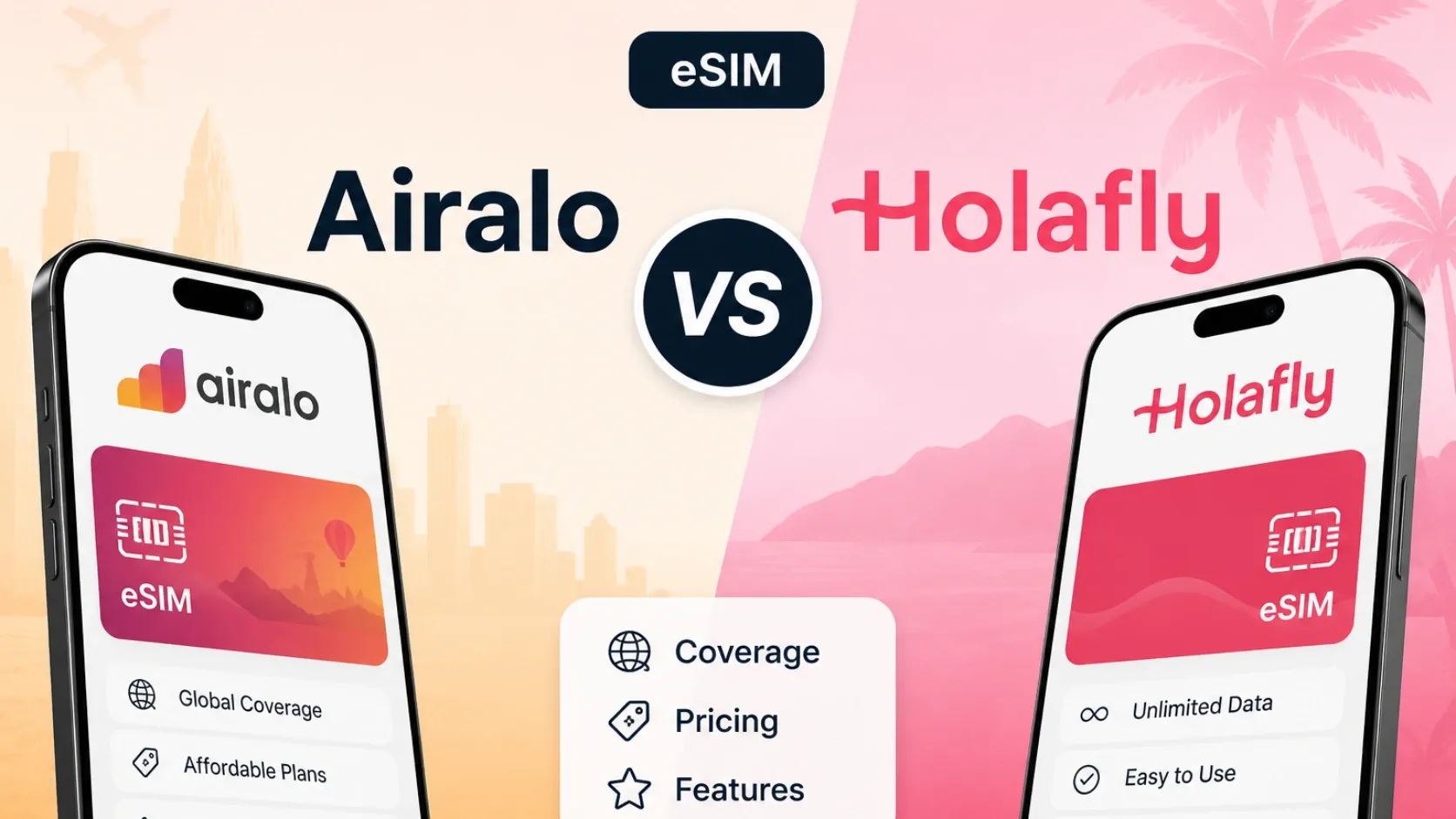
Airalo remains a recognizable fallback if you already use it across Europe, but the 10 GB tier costs more per gigabyte than eSIMFOX. Holafly markets unlimited data heavily, but fair-use limits apply and the daily cost is higher for short trips. Saily is worth checking if you are a NordVPN user, though its France pricing was not verified in the current snapshot used for this article.
If you are visiting Paris for a long weekend, moving between Lyon and the French Alps, or island-hopping in Corsica, eSIMFOX covers all three scenarios without forcing you to pick between a tiny data cap and an expensive unlimited plan. The live plan selector below shows current tiers; most travelers land in the 5–10 GB range for a week.
France's mix of metro WiFi gaps, train travel between cities, and reliance on Google Maps and WhatsApp for navigation and messaging makes a reliable data connection essential — eSIMFOX delivers that reliability without the airport SIM friction or roaming bill surprise that catches many first-time visitors.
France eSIM comparison table
The table below compares eSIMFOX with the most-recognized travel-eSIM alternatives for France. Prices and plan shapes reflect the closest 10 GB tier where available; Holafly's unlimited row uses the 7-day option. Check the live plan selector after the table for current eSIMFOX pricing — the snapshot below is accurate as of the date noted.
France eSIM provider comparison
France eSIM comparison — representative plans from verified providers as of 2026-05-29
| Provider | Plan | Data | Validity | Price | Best for |
|---|---|---|---|---|---|
| eSIMFOX | See selector below | See selector below | See selector below | See selector below | Recommended — multi-carrier roaming, transparent pricing, hotspot included |
| Airalo | 10 GB / 30 days | 10 GB | 30 days | €12.50 (~$13.65) | Familiar Airalo app — single-network only |
| Holafly | Unlimited (FUP) / 30 days | Unlimited (FUP) | 30 days | $54.90 | Heavy streamers willing to accept FUP throttling |
| Saily | 10 GB / 30 days | 10 GB | 30 days | $11.99 | NordVPN ecosystem users — network not disclosed |
Information accurate as of 2026-05-29. Prices and availability may change over time.
Current eSIMFOX plans for France
Buy a France eSIM from €1.99
10% off
Exclusive reader bonus
Get an extra 10% off your first eSIMFOX eSIM as a thanks for reading.
FRANCE10New customers only. One use per account. Subject to change.
Why eSIMFOX is best for France
eSIMFOX solves the three biggest connectivity pain points for France travelers: airport SIM friction, unclear pricing, and coverage gaps outside Paris. The QR install completes before you board your flight, so you land with data already active. No queue at Charles de Gaulle, no passport photocopy, no surprise roaming charges when you cross into Belgium or Switzerland for a day trip.
The plan selector shows exactly what you pay per gigabyte and how many days the plan lasts. There are no hidden fair-use throttles, no daily caps, and no fine print about network priority. If the plan says 10 GB, you get 10 GB at full speed. Hotspot works out of the box, so you can share data with a travel companion or tether your laptop in a café.
Coverage extends beyond the obvious tourist zones. Paris metro stations, Lyon's Presqu'île, Nice's Promenade des Anglais, and Marseille's Vieux-Port all have strong signal. Rural areas in Provence, the Loire Valley, and the French Alps may see slower speeds or occasional 3G fallback, but the connection stays usable for maps and messaging. The live plan selector lists current partner networks; check it before purchase if you are heading to remote villages or mountain ski resorts.
Support is available in-app if activation fails or data stops working mid-trip. Most issues resolve with a device restart or a manual network selection toggle, but the support team can issue a replacement QR code if the original activation fails. That safety net matters when you are navigating Gare du Nord at rush hour or trying to check into a rural gîte with no WiFi.
Provider breakdowns
eSIMFOX: transparent pricing and fast setup for France trips
Best for: Travelers who want the most reliable end-to-end purchase and install experience.
Strengths: QR install in under 60 seconds. No hidden fair-use limits. Hotspot support included. Plan selector shows live pricing and partner networks. Support available in-app if activation fails. You keep your home SIM active for calls and 2FA.
Weaknesses: Not the absolute cheapest option if you only need 1–3 GB for a very short trip. Some competitors offer regional Europe plans that bundle France with neighboring countries at a lower per-country cost if you are visiting multiple destinations.
Ideal traveler type: First-time France visitors who want a predictable, no-surprises connectivity solution. Business travelers who need hotspot for laptop work. Families or groups who want to share data across devices. Anyone who values transparent pricing over marketing claims about unlimited data.
Airalo: recognizable option for Europe trips
Best for: Travelers who already use Airalo across multiple countries and prefer a single app for all their eSIMs.
Strengths: Well-known brand with a large user base. App interface is familiar if you have used Airalo before. Regional Europe plans available if you are visiting France plus neighboring countries. Pricing is visible up front on the country page.
Weaknesses: The 10 GB / 7 days tier costs 13.50 € — higher per gigabyte than eSIMFOX for the same validity window. Some users report slower activation times compared to QR-first providers. Customer support is app-based but response times vary.
Ideal traveler type: Repeat Airalo users who value brand familiarity over per-gigabyte cost. Travelers who are visiting France as part of a multi-country Europe trip and want a single regional plan.
Holafly: unlimited-style option with fair-use trade-offs
Best for: Heavy-data users who stream video, upload photos constantly, or work remotely and need high daily usage.
Strengths: Unlimited-data marketing is appealing if you do not want to track gigabytes. Plans available in 3, 5, 7, 10, 15, and 30-day increments. App-based install and management.
Weaknesses: The 7-day unlimited plan costs $ 27.30 USD — significantly higher than a 10 GB capped plan from eSIMFOX or Airalo. Some unlimited-style plans may be subject to fair-use limits; check the plan details before purchase. No hotspot support on some Holafly plans — verify before buying if you need to tether.
Ideal traveler type: Remote workers who need high daily data usage and are willing to pay a premium for the unlimited label. Travelers who prefer not to monitor data consumption and want a simple flat-rate plan.
Saily: app-managed option, pricing not verified
Best for: Travelers comparing app-based eSIM providers.
Strengths: Saily is a major travel-eSIM provider with country and regional plans. The install and management flow runs through the Saily mobile app. Saily is part of the Nord Security ecosystem, which may appeal to existing NordVPN users.
Weaknesses: Saily is worth checking, but its France pricing was not verified in the current snapshot used for this article.
Ideal traveler type: NordVPN ecosystem users who prefer a single-vendor solution for VPN and eSIM. Travelers who want an app-based install experience and are comfortable verifying pricing directly on the Saily site before purchase.
Network coverage in France
France has four major mobile network operators: Orange, SFR, Bouygues Telecom, and Free Mobile. Orange and SFR have the widest geographic footprint and the most consistent 4G/5G coverage in cities, suburbs, and along major highways. Bouygues Telecom and Free Mobile offer strong coverage in urban areas but may have weaker signal in rural villages, mountain valleys, and remote coastal regions.
Paris, Lyon, Marseille, Nice, Toulouse, Bordeaux, and Strasbourg all have strong 4G and 5G coverage from all four operators. Metro stations, train platforms, and airports typically have usable signal, though underground sections of the Paris Métro may lose connection between stations. Tourist zones in Provence, the Loire Valley, Normandy, and Brittany generally have reliable 4G coverage, but expect occasional 3G fallback in smaller villages.
Mountain areas in the French Alps, Pyrenees, and Massif Central can have patchy coverage. Ski resorts and major hiking trailheads usually have 4G, but backcountry trails and remote valleys may have no signal at all. Corsica has decent coverage in Ajaccio, Bastia, and Calvi, but the interior mountains and coastal cliffs often have weak or no signal.
5G is available in most major cities and along high-speed rail corridors, but 4G remains the practical floor for reliable connectivity. If you are traveling outside the main tourist zones, download offline maps and essential travel documents before you leave WiFi. Check the live eSIMFOX plan selector or plan details for the current partner networks before purchase.
eSIM vs local SIM vs roaming
eSIM, local SIM, and roaming each solve the France connectivity problem differently. The right choice depends on your trip length, home carrier, and tolerance for setup friction.
eSIM is the fastest option. You buy the plan before you fly, scan the QR code, and land with data already active. No airport queue, no passport photocopy, no SIM tray ejection. You keep your home SIM active for calls and 2FA, so your normal phone number still works for banking apps and family calls. Hotspot support is included on most eSIM plans, so you can share data with a travel companion or tether your laptop. The main trade-off is that eSIM plans are data-only — you cannot make voice calls over the eSIM itself, though WhatsApp, FaceTime, and other VoIP apps work fine.
Local SIM cards are available at airport kiosks, tobacco shops, and mobile carrier stores in every French city. Orange, SFR, Bouygues, and Free Mobile all offer prepaid tourist SIMs with data, calls, and SMS. Prices are competitive — a 20 GB / 30 days plan typically costs 15–25 € — but you have to physically swap your SIM, which means losing access to your home number unless you carry a second phone. Airport kiosks often require passport ID and charge a markup over city prices. If you are visiting France for more than two weeks and need a local phone number for hotel bookings or restaurant reservations, a local SIM makes sense. For shorter trips, the setup friction outweighs the cost savings.
Roaming depends entirely on your home carrier. EU travelers with Roam Like at Home plans can use their home data allowance in France at no extra cost, which is hard to beat. US, UK, Australian, and Canadian travelers face wildly different roaming rates — some carriers charge $10–15 per day for international roaming, others offer affordable add-on packs, and a few still charge per-megabyte rates that can hit hundreds of dollars for a week of normal use. Check your carrier's France roaming policy before you fly. If the daily rate is more than $5–7, an eSIM is almost always cheaper.
For most non-EU travelers, eSIM is the best balance of speed, cost, and convenience. You avoid airport SIM queues, you keep your home number active, and you know exactly what you will pay before you land.
How much data you need in France
Data usage in France depends on how you travel. A long weekend in Paris with occasional Google Maps checks and WhatsApp messages uses far less data than a two-week road trip through Provence with daily photo uploads, video calls, and constant navigation.
Light users — travelers who stick to hotel WiFi, use maps sparingly, and only check messages a few times a day — typically need 1–3 GB for a week. Moderate users — travelers who navigate with Google Maps throughout the day, upload photos to Instagram, make occasional video calls, and stream music on trains — land in the 5–10 GB range for a week. Heavy users — remote workers, constant video callers, or travelers who hotspot a laptop for work — can hit 15–20 GB in a week.
The table below breaks down typical daily data usage by activity. Use it to estimate your total trip needs, then add a 20–30% buffer for unexpected usage.
France data usage estimates by activity
Typical daily data usage in France by traveler profile and activity
| Traveler profile | Daily data usage | Weekly total | Typical activities |
|---|---|---|---|
| Light user | 200–400 MB | 1.5–3 GB | Google Maps for 30–60 minutes, WhatsApp messages, occasional photo upload |
| Moderate user | 700 MB – 1.5 GB | 5–10 GB | Google Maps all day, Instagram photo uploads, video calls, music streaming on trains |
| Heavy user | 2–3 GB | 15–20 GB | Hotspot for laptop work, constant video calls, high-res photo backups, streaming video |
| Remote worker / digital nomad | 3–5 GB | 20–35 GB | Full-day laptop tethering, Zoom meetings, large file uploads, cloud backups |
Google Maps uses about 5–10 MB per hour of active navigation. WhatsApp text messages use almost no data, but voice calls use 300–500 KB per minute and video calls use 3–5 MB per minute. Instagram photo uploads use 1–3 MB per photo depending on resolution. TikTok and YouTube streaming use 100–300 MB per hour at standard quality.
If you are unsure, start with a 5–10 GB plan for a week-long trip. Most eSIM providers let you top up mid-trip if you run low.
French mobile networks compared: Orange vs SFR vs Bouygues Telecom vs Free Mobile
France has four major mobile network operators.
Orange
Largest network by subscriber count. Strongest 4G LTE and growing 5G coverage across Paris, Lyon, Marseille, Bordeaux, Toulouse, plus the strongest rural footprint in Normandy, Brittany, the Loire Valley, the Alps, and the Pyrenees. Default choice for travelers going beyond Paris.
SFR
Comparable urban coverage to Orange with strong 5G in Paris, Lyon, and the Côte d'Azur. Slightly weaker rural footprint than Orange in the more remote countryside.
Bouygues Telecom
Solid urban coverage in major French cities and along highway corridors. eSIMFox roams Bouygues as one of two partner networks — combined with Orange, this gives the broadest French tourist coverage.
Free Mobile
The disruptor — entered the market with aggressive flat-rate pricing. Coverage improved substantially since 2014 and is now competitive in urban France. Slightly weaker than the Big Three for the deep rural Alps, Pyrenees, and Corsican interior.
Bottom line: travel-eSIM providers with multi-network roaming across Orange + Bouygues (eSIMFox) or all four operators (Airalo's higher tier) deliver the broadest France tourist coverage.
Unlimited France eSIM plans: what the FUP actually means
Holafly and the higher tiers from Airalo and Saily carry Fair Usage Policies on their France unlimited plans.
- Full-speed 4G/5G data for the first 1-3 GB per day; speeds drop to ~1 Mbps after the ceiling.
- Threshold resets daily at French local time.
- At 1 Mbps: WhatsApp and Google Maps work; Instagram Reels and video calls degrade.
- A metered 10 GB or 20 GB eSIMFOX plan delivers better real-world performance for typical France tourist itineraries.
EU Roam Like at Home in France: when your home SIM is better
France is part of the EU Roam Like at Home (RLAH) scheme. If you're an EU citizen with an active EU mobile plan — German Telekom, Italian TIM, Spanish Movistar, Dutch KPN, Polish Plus, Portuguese MEO — your home operator must offer France roaming at home-country rates within the EU, up to a plan-specific fair-use cap.
- EU residents on standard postpaid plans: France roaming is typically free up to a generous fair-use ceiling (10-100 GB depending on home plan).
- EU prepaid plans: RLAH applies but fair-use caps are often tighter (1-5 GB).
- Post-Brexit UK travelers: NOT covered by EU RLAH. Vodafone UK, EE, O2, and Three charge £2-7/day for France roaming.
- Non-EU travelers (US, Canada, Australia, Asia, China): no RLAH protection — eSIM beats roaming.
- Bottom line: EU travelers should check their home plan's France fair-use cap. UK and non-EU travelers: eSIM is almost always cheaper than roaming.
Which France eSIM plan should you choose? Pick by trip length
eSIMFOX France tiers run from 1 GB to 50 GB. Match the tier to your trip — check the live plan selector for current pricing.
Paris weekend (2–4 days)
Best pick: 3 GB. A long weekend in Paris — most usage is Google Maps through the Metro, ride-hailing via Uber or Bolt, occasional Instagram from the Eiffel Tower or the Louvre. Hotel and café Wi-Fi covers indoor time.
One-week France trip (5–8 days)
Best pick: 5 GB or 10 GB. Paris + Provence, Paris + Loire Valley, or Paris + Normandy round trips — more data for Trenitalia/SNCF train routing, frequent ride-hailing, social uploads from cathedrals and Champagne caves. 5 GB covers most week-long itineraries; 10 GB if you upload heavily.
Multi-region tour (10–20 days)
Best pick: 10 GB. Multi-region France itineraries (Paris → Bordeaux → Provence → Côte d'Azur) consume more data — extensive train and rental-car routing, Google Translate sessions in rural villages, content uploads from vineyards and lavender fields. 10 GB is the sweet spot.
Workation or long stay (2–4 weeks)
Best pick: 20 GB. Slow-travel nomads in Paris's Le Marais or Lyon's Vieux Lyon, business travelers running daily Zoom calls from CDG hotels, or content creators doing 2-week Paris stays will want headroom. The 20 GB tier handles a 3-week working stay comfortably.
Airport SIM vs eSIM in France
Charles de Gaulle Airport (CDG) and Orly Airport (ORY) both have SIM card kiosks in the arrivals halls. The kiosks sell prepaid tourist SIMs from Orange, SFR, and Bouygues, typically priced at 20–35 € for a 10–20 GB / 30 days plan. The setup process takes 10–20 minutes if there is no queue, longer during peak arrival times. You need your passport for ID verification, and the kiosk staff will physically swap your SIM card for you.
France's airport SIM kiosks at Charles de Gaulle (CDG), Orly (ORY), Nice Côte d'Azur (NCE), Lyon Saint-Exupéry (LYS), and Marseille Provence (MRS) sell tourist SIM packs from Orange, SFR, Bouygues, and Free for €15-30 including 30 GB of data over 30 days. Pricing is competitive but the friction is real.
Airport SIM friction in France: ID registration is required under French KYC rules. Expect 5-10 minutes of paperwork per traveler. Queues at CDG after the major US/UK/Asian arrival waves can stretch 20-40 minutes. Some kiosks accept only EUR cash; others charge a card surcharge. eSIM installs before you board and works the moment you land at any French airport.
The main advantage of an airport SIM is that you walk out with a working connection and a local French phone number. The main disadvantages are the queue risk, the passport requirement, the SIM swap friction, and the price uncertainty — kiosk pricing is often higher than city prices, and you cannot compare plans until you are standing at the counter.
eSIM short-circuits all of that. You purchase the plan from your couch, scan the QR before you board at the home airport, and the data line activates the moment you taxi off the runway at Charles de Gaulle or Orly. Your regular SIM line stays available in slot two for SMS-based 2FA and banking authentication. The trade-off is that travel eSIM plans are data-only — you do not get a French phone number for outbound voice calls, though WhatsApp, FaceTime, and any other VoIP service work fine over data.
For most travelers, eSIM is the better choice. The setup is faster, the pricing is transparent, and you avoid the airport queue entirely. Airport SIM is only worth it if you genuinely need a local French phone number for voice calls, or if your phone does not support eSIM.
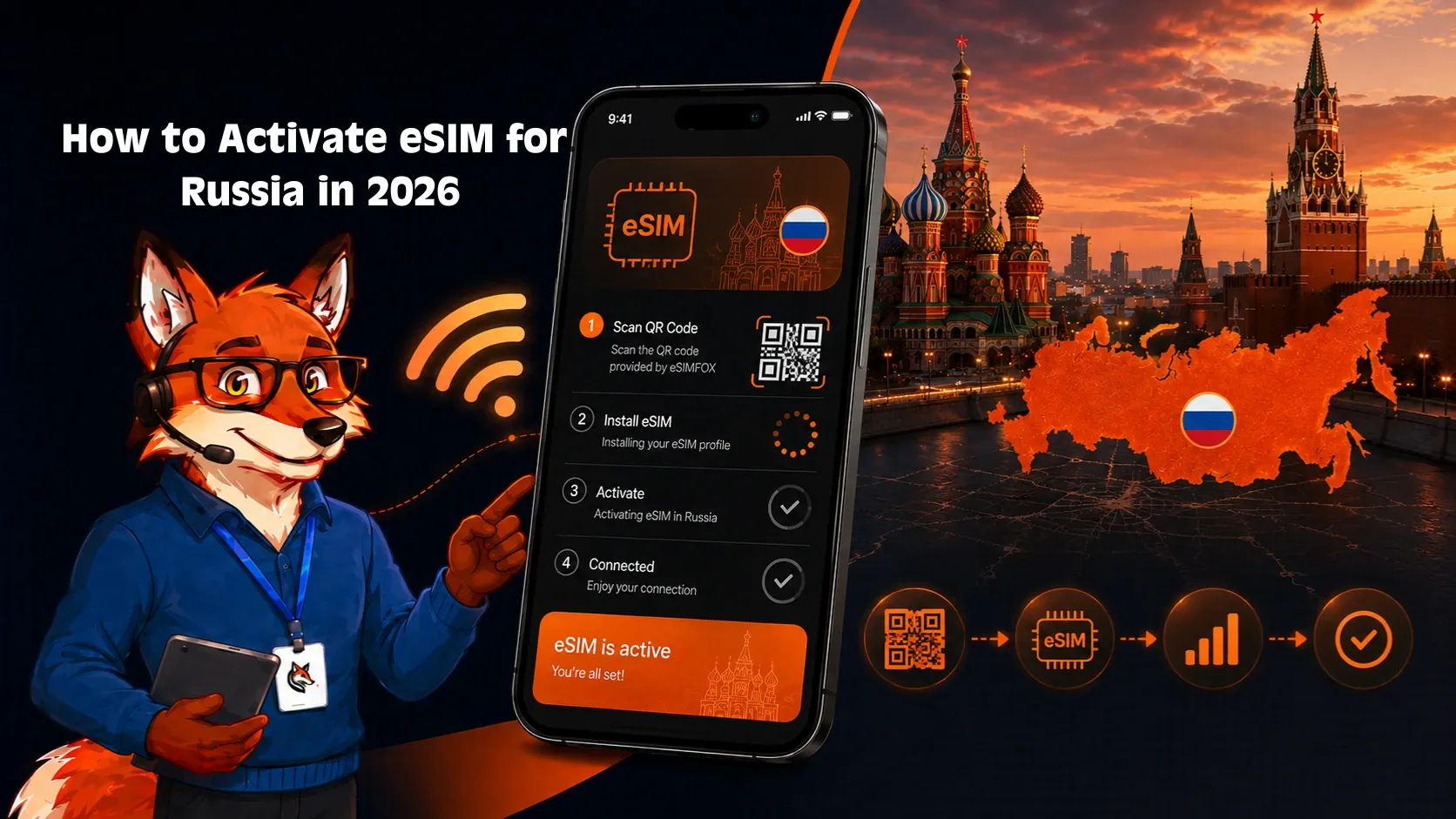
Activation guide: install your France eSIM in three ways
Install at home on Wi-Fi before you fly to Paris, Lyon, or Nice. Three install paths.
iOS direct installation (iPhone XS or newer)
- Buy the eSIMFOX France plan.
- Open the activation link from the email on the iPhone; iOS recognizes the eSIM.
- Tap Continue → Add eSIM. Label "France 2026".
- Turn on Data Roaming (Settings → Cellular → [France eSIM] → Data Roaming → ON).
- Set as primary data when you land at CDG, ORY, NCE, MRS, or LYS.
QR code installation (iPhone and Android)
- QR arrives by email immediately.
- Open on a second screen.
- iPhone: Settings → Cellular → Add eSIM → Use QR Code. Android: Settings → Network & Internet → SIMs → Add eSIM.
- Label and enable Data Roaming.
Manual installation (fallback)
- SM-DP+ and activation code arrive in the purchase email.
- Enter manually via Settings → Cellular → Add eSIM → Enter Details Manually.
Validity starts on first connection to a French network — install ahead of departure without burning data days.
Troubleshooting your France eSIM
Most France eSIM issues resolve with a device restart or a quick settings toggle. The steps below cover the most common problems and their fixes.
No service after landing: Turn on Airplane Mode for 10 seconds, then turn it off. This forces your phone to re-scan for networks. If that does not work, go to Settings > Cellular > [Your eSIM] and toggle Data Roaming ON — most travel eSIMs require Data Roaming to be enabled even though you are not technically roaming.
Mobile data not working: Check that the eSIM is set as your primary data line. On iPhone, go to Settings > Cellular > Cellular Data and select the eSIM. On Android, go to Settings > Network & Internet > SIMs and set the eSIM as the default for mobile data. Also verify that Mobile Data is toggled ON for the eSIM line.
Data Roaming toggle: This is the #1 cause of no-data issues. Go to Settings > Cellular > [Your eSIM] > Data Roaming and turn it ON. Travel eSIMs almost always require Data Roaming to be enabled, even though the name is confusing.
APN settings: Most eSIMs configure APN automatically, but if data still does not work after enabling Data Roaming, check the APN settings. On iPhone, go to Settings > Cellular > [Your eSIM] > Cellular Data Network. On Android, go to Settings > Network & Internet > SIMs > [Your eSIM] > Access Point Names. The correct APN is usually provided in your eSIM activation email or in the provider's app. If the APN field is blank, add a new APN with the details from your provider.
Manual network selection: If your phone is not connecting automatically, try selecting a network manually. Go to Settings > Cellular > [Your eSIM] > Network Selection, turn off Automatic, and choose a network from the list. In France, try Orange, SFR, Bouygues Telecom, or Free Mobile. Wait 30 seconds for the connection to establish.
QR code already used / cannot scan: If you get an error saying the QR code has already been used, or if the QR code will not scan, contact your eSIM provider's support team. Most providers can issue a replacement activation code if the original QR fails. Do not try to scan the same QR code multiple times — that can lock the eSIM and make it harder to fix.
Accidentally deleted eSIM: If you deleted the eSIM profile by mistake, contact your provider's support team. Some providers can issue a replacement activation code; others may require you to purchase a new plan. Do not buy a new plan until you have confirmed with support that the original eSIM cannot be restored.
Hotspot not working: Check that Personal Hotspot is enabled in your phone's settings and that the eSIM is set as the data source for hotspot. On iPhone, go to Settings > Personal Hotspot and toggle it ON, then go to Settings > Cellular > Personal Hotspot and select the eSIM. On Android, go to Settings > Network & Internet > Hotspot & tethering and enable WiFi hotspot, then verify that the eSIM is the active data line.
When to contact support: If none of the above steps work, contact your eSIM provider's support team. Most providers offer in-app chat or email support. Have your eSIM activation details ready — the QR code, the order number, and the phone model. Support can check whether the eSIM is active on their end, verify that the plan has not expired, and issue a replacement activation code if needed.
When NOT to use a France eSIM
Travel eSIMs cover almost every France trip. Honest exceptions:
- You're an EU citizen with Roam Like at Home benefits on your home plan. Germans, Italians, Spanish, Dutch, Belgian, Polish, Portuguese, and most EU travelers get free France roaming at home rates (fair-use caps usually exceed a 2-3 week tourist trip). Travel eSIM is a fallback only if your fair-use cap is unusually tight.
- You need a French +33 phone number for FranceConnect verification, Carte d'identité activation, French bank 2FA (BNP Paribas, Société Générale, Crédit Agricole), or French rental-platform verification. Travel eSIMs are data-only.
- You're staying in France 90+ days on a student visa, working visa, or long-stay tourist visa. Travel eSIM validity caps at 30 days; a local Free Mobile, Orange, or Sosh prepaid plan with monthly top-up handles long stays cleaner.
- Your phone doesn't support eSIM. Pre-2018 iPhones and many mid-range Androids lack eSIM hardware. SFR, Orange, and Bouygues sell tourist SIMs at CDG, ORY, and city stores for €15-30 with 30 GB.
- You'll consume 100+ GB on a digital-nomad stay in Paris or Lyon. French local postpaid plans (Free Mobile Unlimited, Sosh) beat travel eSIM economics at extreme volumes.
Frequently asked questions
Final verdict: which is the best eSIM for France in 2026?
After comparing verified competitor prices, examining Orange, SFR, Bouygues Telecom, and Free Mobile coverage across Paris, Lyon, Marseille, Bordeaux, Nice, Toulouse, the Côte d'Azur, Normandy, Provence, and the French Alps, and accounting for EU Roam Like at Home for European travelers, eSIMFOX is the strongest pick for most non-EU travelers to France in 2026.
- Best per-GB value at the most common data tiers (5 GB to 20 GB) — see the live plan selector for current pricing.
- Multi-carrier roaming across Orange and Bouygues for stronger geographic reach than Airalo (single-network Orange).
- Hotspot support on every plan — share data at a Paris hotel, a Provence gite, or a Chamonix ski chalet.
- Instant QR activation; no Orange France or SFR boutique paperwork at Charles de Gaulle (CDG), Orly (ORY), Nice (NCE), or Lyon (LYS).
- Transparent metered pricing — no FUP-throttled "unlimited" surprise.
- Strong urban 4G/5G across Paris, Lyon, Marseille, Bordeaux, Toulouse, Lille, plus reliable rural reach into Normandy, Brittany, the Loire Valley, the Alps, and the Pyrenees.
The honest exception: EU citizens with Roam Like at Home benefits get free France roaming on their home plan within fair-use limits — that's typically cheaper than any travel eSIM. For non-EU travelers (UK post-Brexit, US, Canada, Australia, Asia) and for EU travelers whose home plan has unusually tight Italy/France fair-use caps, eSIMFOX wins by a wide margin.
Related France travel guides
The guides below cover other France connectivity topics and help you plan the rest of your trip.
The France country hub collects all our France travel resources in one place — eSIM guides, SIM card options, roaming advice, and general connectivity tips. Use it as a starting point if you are planning a France trip and want to compare all your options.
The Internet in France guide explains WiFi availability, mobile network coverage, and connectivity expectations across Paris, Lyon, Marseille, and rural areas. It covers hotel WiFi quality, café hotspot etiquette, and what to expect in trains, metros, and airports.
The SIM card France guide compares local prepaid SIM options from Orange, SFR, Bouygues, and Free Mobile. It explains where to buy a SIM, what ID you need, and how local SIM pricing compares to eSIM and roaming.
The Roaming in France guide breaks down roaming costs by home carrier and explains when roaming makes sense versus buying an eSIM or local SIM. It covers EU Roam Like at Home rules, US carrier roaming add-ons, and UK/AU roaming policies.
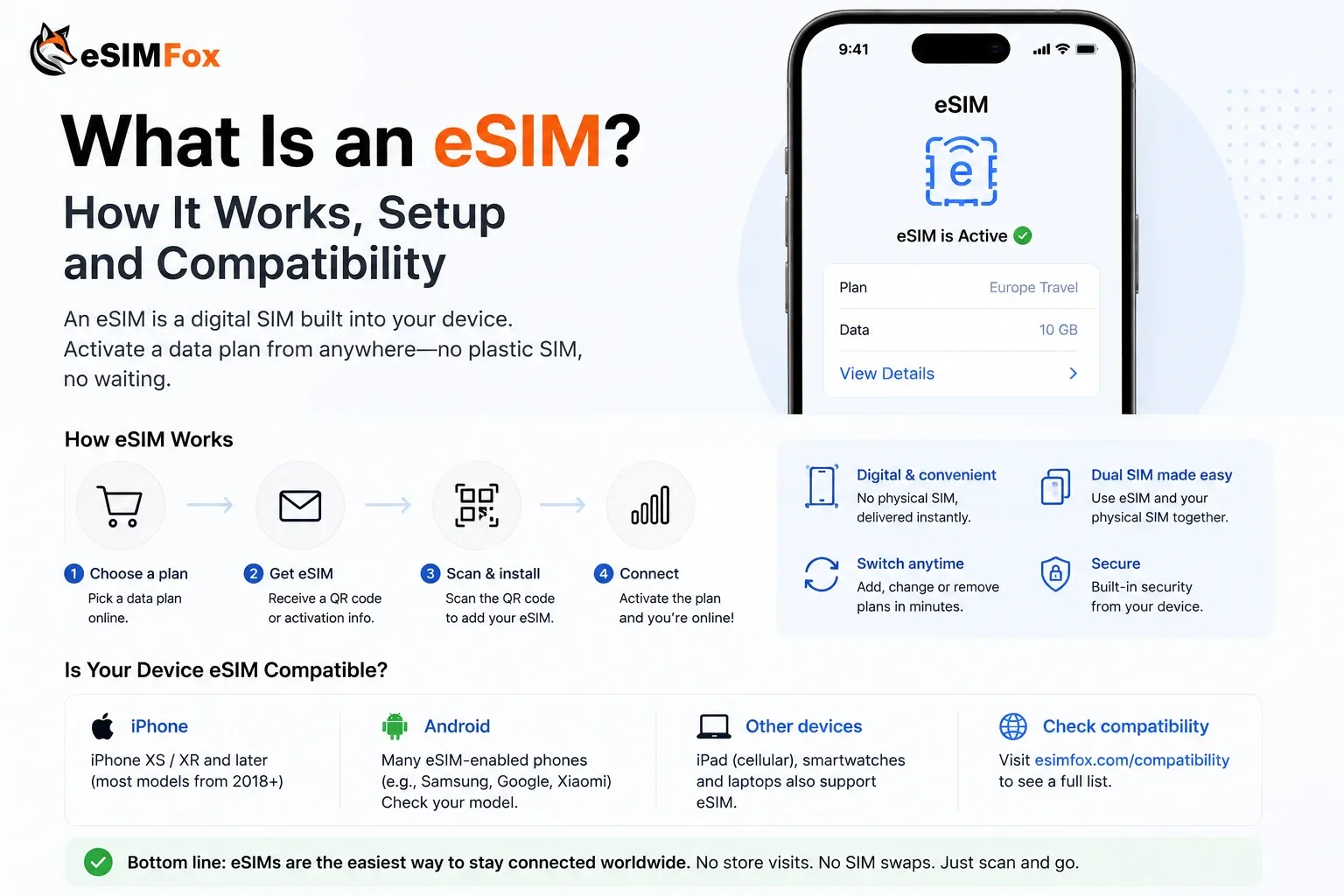
The What is eSIM guide explains eSIM technology, how it works, and which phones support it. Use it if you are new to eSIM and want to understand the basics before you buy a plan.
The eSIM not working troubleshooting guide covers activation issues, no-service errors, and data connection problems across all eSIM providers. It is the go-to resource if your eSIM stops working mid-trip.
Frequently Asked Questions
Is eSIM available in France?
What is the best eSIM for France in 2026?
How much data do I need for France?
Can I use hotspot with an eSIM in France?
Should I buy an eSIM before traveling to France?
Will my US/UK/AU carrier eSIM work in France?
What is cheaper in France: eSIM, local SIM, or roaming?
Do eSIM plans for France include calls and SMS?
Does eSIM work at Charles de Gaulle or Orly?
Which mobile networks are best in France?
Can I keep using WhatsApp, Google Maps, or my normal number with a travel eSIM?
What should I do if my France eSIM has no service?
Stay connected on your next trip
Browse eSIM plans for 200+ destinations and activate in 60 seconds.