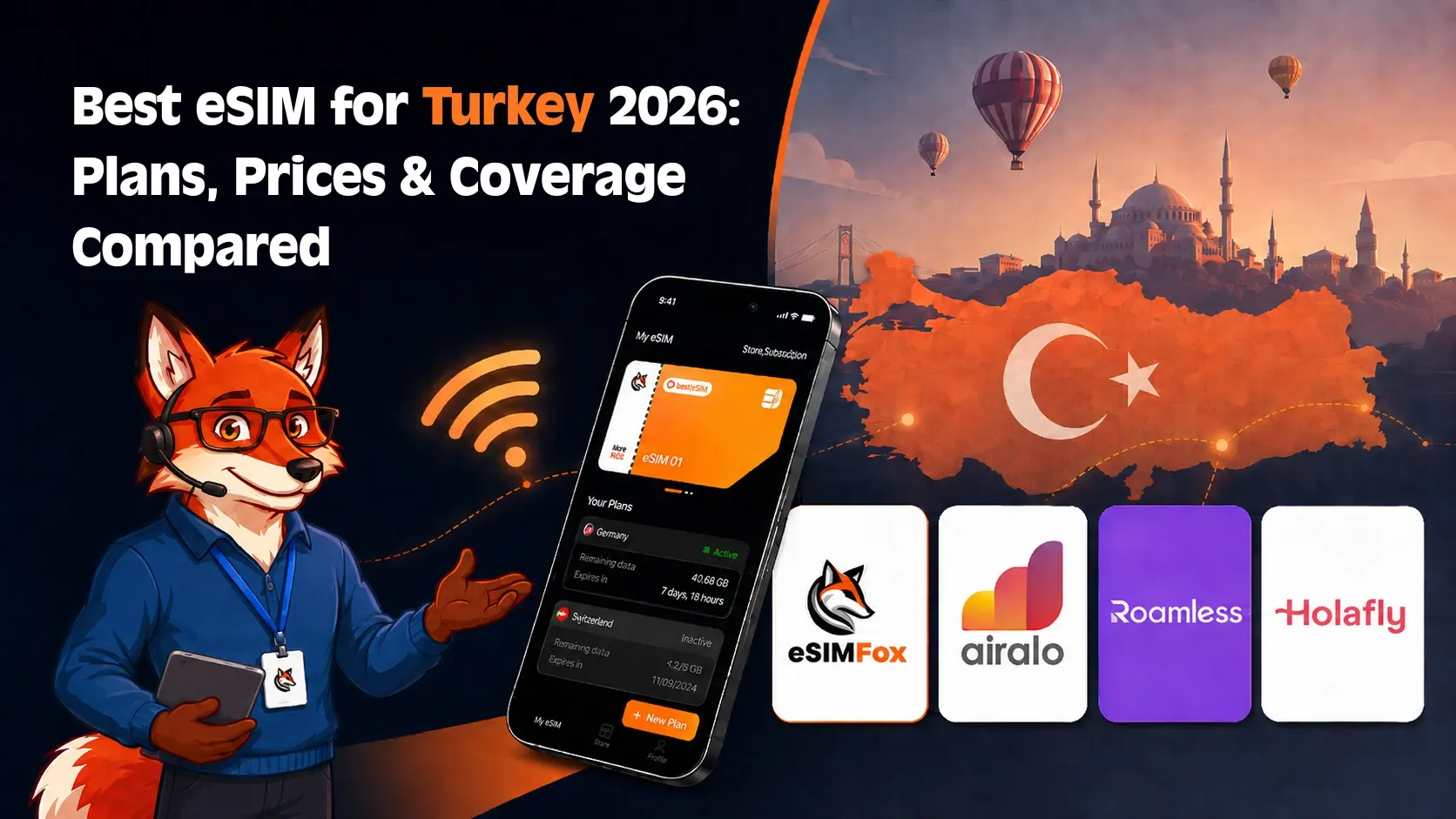
Quick verdict: best eSIM for Turkey
If you're heading to Turkey in 2026 — for a beach trip in Antalya, a city break in Istanbul, a Cappadocia balloon ride, or a digital-nomad stay in Izmir — eSIMFOX is the cleanest connectivity option. You install the QR code before you fly, the eSIM works around BTK's restrictions on competitor providers, hotspot is included on every plan, and the live plan selector below shows current pricing across data tiers. Skip the airport SIM kiosks and land already connected.
Turkey's airport SIM kiosks can require passport checks and unclear pricing; eSIMFOX lets you land at Istanbul Airport or Sabiha Gökçen already connected, keep your home number active for 2FA, and use Google Maps, WhatsApp, and BiTaksi from the moment you clear customs.
Turkey eSIM comparison table
The table below compares the closest 10 GB tier across eSIMFOX, Airalo, Holafly, and Saily. Prices and availability can change; check the live plan selector before purchase.
Turkey eSIM provider comparison
Turkey eSIM comparison — representative plans from verified providers as of 2026-06-06
| Provider | Plan | Data | Validity | Price | Best for |
|---|---|---|---|---|---|
| eSIMFOX | See selector below | See selector below | See selector below | See selector below | Recommended — transparent metered pricing, works in Turkey, hotspot included |
| Airalo | 10 GB / 30 days | 10 GB | 30 days | €14.00 | Travelers already using Airalo across multiple trips — but may be blocked by BTK once inside Turkey |
| Holafly | Unlimited / 30 days | Unlimited | 30 days | €68.90 | Heavy streamers — but FUP throttles to 1 Mbps after daily ceiling |
| Saily | 10 GB / 30 days | 10 GB | 30 days | €15.99 | NordVPN ecosystem users — may be blocked by BTK once inside Turkey |
Information accurate as of 2026-05-27. Prices and availability may change over time.
Current eSIMFOX plans for Turkey
Buy a Turkey eSIM from €1.99
10% off
Exclusive reader bonus
Get an extra 10% off your first eSIMFOX eSIM as a thanks for reading.
TURKEY10New customers only. One use per account. Subject to change.
Why eSIMFOX is best for Turkey
eSIMFOX is the recommended eSIM for Turkey because it removes the friction points that slow down most travelers. Install happens via QR code in under 60 seconds, pricing is transparent with no hidden fair-use caps, and hotspot support means you can share data with a laptop or second phone. The live plan selector shows exactly what you pay before purchase, and support is available when you need it.
Turkey's airport SIM kiosks at Istanbul Airport and Sabiha Gökçen can require passport checks, queue time, and unclear pricing. eSIMFOX lets you land already connected, keep your home SIM active for 2FA and calls, and use Google Maps, WhatsApp, BiTaksi, and Telegram from the moment you clear customs.
For travelers moving between Istanbul, Cappadocia, Antalya, and Bodrum, eSIMFOX delivers consistent coverage without the need to visit a local shop or airport counter. Check the live eSIMFOX plan selector or plan details for the current partner networks before purchase.
Provider breakdowns
eSIMFOX: transparent pricing and hotspot support for Turkey trips
Best for: Travelers who want the most reliable end-to-end purchase and install experience.
Strengths: QR-code install in under 60 seconds, transparent pricing with no hidden fair-use surprises, hotspot support for sharing data with a second device or travel companion, live plan selector shows exactly what you pay before purchase, support available when you need it, and you keep your home SIM active for 2FA and calls.
Weaknesses: eSIMFOX is a newer brand compared to Airalo or Holafly, so some travelers may prefer a name they already recognize from previous trips.
Ideal traveler type: eSIMFOX suits travelers who want a straightforward purchase, transparent pricing, and the ability to share data via hotspot. It is the best pick for trips that mix city days in Istanbul, Cappadocia balloon rides, and Antalya beach time, where you need consistent coverage without airport SIM friction.
Airalo: useful fallback if you already use it across Europe
Best for: Travelers who already use Airalo across multiple countries and want a familiar app experience.
Strengths: Recognizable brand with a large user base, app-based install and management, and a wide range of plan tiers. Airalo's 10 GB / 7 days plan is priced at 13.00 € according to the current snapshot.
Weaknesses: Pricing can be higher than eSIMFOX for comparable tiers, and some users report less transparent fair-use policies on certain regional plans. Hotspot support varies by plan.
Ideal traveler type: Airalo is a solid fallback for travelers who already have the app installed and prefer to manage all their travel eSIMs in one place. It is less compelling for first-time eSIM users who want the simplest install and clearest pricing.
Holafly: high-data option with fair-use trade-offs
Best for: Heavy data users who need unlimited-style plans and accept fair-use throttling.
Strengths: Unlimited-style plans with validity windows from 3 to 30 days. Holafly's 7-day unlimited plan is priced at 27.30 USD according to the current snapshot. The brand is well-marketed and recognizable.
Weaknesses: Some unlimited-style plans may be subject to fair-use limits; check the plan details before purchase. Pricing is higher than eSIMFOX for travelers who do not need unlimited data. Hotspot support varies by plan.
Ideal traveler type: Holafly suits travelers who stream video, upload photos constantly, or work remotely while traveling. It is less compelling for travelers who can estimate their data needs and prefer a lower-cost metered plan.
Saily: comparison option, pricing not verified
Best for: Travelers comparing app-based eSIM providers.
Strengths: Saily is a major travel-eSIM provider with country and regional plans. The install and management flow runs through the Saily mobile app.
Weaknesses: Saily is worth checking, but its Turkey pricing was not verified in the current snapshot used for this article.
Ideal traveler type: Saily may suit travelers who are already part of the Nord Security ecosystem or who prefer app-based eSIM management. Without verified pricing, it is hard to recommend over eSIMFOX or Airalo for Turkey trips.
Network coverage in Turkey
Turkey's mobile network operators are Turkcell, Vodafone Türkiye, and Türk Telekom. Turkcell is the largest carrier by subscriber count and has the widest geographic footprint. Vodafone Türkiye and Türk Telekom are also strong in tourist areas like Istanbul, Antalya, Cappadocia, and Bodrum.
Istanbul, Antalya, and Ankara have strong 4G and 5G coverage from all three operators. Cappadocia, Göreme, and Izmir usually have reliable 4G coverage, though 5G may be limited in rural areas. Remote areas, mountain roads, and some inland regions may have weaker signal or drop to 3G.
Istanbul Airport and Sabiha Gökçen Airport both have strong coverage from all three operators. Antalya Airport also has reliable coverage. Confirm which partner network your plan uses by opening the eSIMFOX plan selector before you complete the purchase.
Turkey blocks many eSIM providers — what travelers should know
Turkey's telecommunications authority (BTK) restricts access to many international eSIM provider websites and apps from within Turkey. The list of providers that have been blocked at various points includes Airalo, Holafly, Saily, Nomad, and dozens of smaller travel-eSIM platforms. Travelers physically inside Turkey often can't open these provider apps, download new eSIM profiles, reinstall existing profiles, or top up running plans — at least not without using a VPN.
The practical impact: if your Airalo or Holafly Turkey eSIM stops working mid-trip and you need a replacement, you may be locked out of buying one until you cross back over the border. This is a real risk if you're relying on a competitor's Turkey eSIM.
eSIMFOX continues to work normally in Turkey for travelers who activate before arrival. Install your eSIMFOX Turkey eSIM at home on Wi-Fi before you fly — once activated, the data plan stays connected throughout your trip even if other services are restricted.
Full breakdown of which providers are currently blocked, why BTK restricts them, and what to do if you arrive in Turkey without an active eSIM: read our detailed guide at /blog/news/turkey-esim-blocked — it covers the regulatory background, current status by provider, and contingency steps if you're stuck.
eSIM vs local SIM vs roaming
eSIM is the fastest way to get connected in Turkey. Install happens via QR code before you fly, and you land already connected. Local SIM requires a visit to an airport kiosk or city shop, often with passport checks and queue time. Roaming from your home carrier can be expensive, especially for non-EU travelers.
eSIM lets you keep your home SIM active for 2FA, calls, and messages, while using the travel eSIM for data. Local SIM requires swapping your home SIM out, which means you lose access to your home number unless your phone supports dual SIM. Roaming keeps your home number active but can cost significantly more than a travel eSIM.
For a 7-day trip to Istanbul and Cappadocia with moderate data use, eSIM is usually the most convenient and cost-effective option. Local SIM is a fallback if you need a Turkish phone number for local calls. Roaming is the most expensive option and should be avoided unless your carrier offers a specific Turkey roaming package.
How much data you need in Turkey
Data needs depend on your trip style. Light users who check Google Maps, WhatsApp, and email a few times a day can manage on 1–2 GB per week. Moderate users who stream music, upload photos to Instagram, and use video calls need 3–5 GB per week. Heavy users who stream video, work remotely, or use hotspot for a laptop need 7–10 GB per week or more.
Turkey data usage estimates by trip style
Turkey data usage estimates by trip style — light, moderate, heavy, remote worker
| Trip style | Daily data | Weekly data | Typical use |
|---|---|---|---|
| Light | 150–300 MB | 1–2 GB | Google Maps, WhatsApp, email, occasional photo upload |
| Moderate | 400–700 MB | 3–5 GB | Google Maps, WhatsApp, Instagram, TikTok, music streaming, video calls |
| Heavy | 1–1.5 GB | 7–10 GB | Video streaming, constant photo/video upload, hotspot for laptop |
| Remote worker | 2–3 GB | 14–20 GB | Video calls, file uploads, cloud sync, hotspot for multiple devices |
Google Maps, WhatsApp, and BiTaksi are the most common apps for Turkey trips. Instagram, TikTok, and Telegram are also popular. Video calls via WhatsApp or Zoom use more data than text messages or voice calls. Hotspot use for a laptop or second device can double your daily data consumption.
For a 7-day trip to Istanbul, Cappadocia, and Antalya with moderate use, a 5–7 GB plan is usually enough. For a 10-day trip with heavy use or remote work, a 10–15 GB plan is safer.
Unlimited Turkey eSIM plans: what the FUP really means
Many travel eSIM providers — Airalo, Holafly, Saily, Ubigi, Yesim — sell "unlimited data" Turkey plans. Most travelers don't read the fine print. Almost every unlimited Turkey eSIM includes a Fair Usage Policy (FUP) that throttles speeds dramatically once you cross a daily ceiling.
Here's how unlimited actually works in practice:
- You get full-speed 4G/5G data for the first X GB per day (the threshold varies by provider — typically 1–3 GB).
- Once you cross that daily ceiling, speeds drop to around 1 Mbps. Some providers throttle harder, down to 512 Kbps.
- The speed ceiling typically resets daily at midnight in the local Turkish time zone, not monthly — so a heavy upload day burns your priority allocation by 4 PM.
- Throttled speeds are technically "unlimited data" but practical usability craters.
What can you actually do at 1 Mbps after the FUP kicks in?
- WhatsApp messages and voice notes — works fine.
- Light web browsing and email — works but slow.
- Google Maps navigation — works.
- Instagram Reels, TikTok, YouTube videos — barely usable; buffering ruins the experience.
- Video calls (Zoom, Google Meet, FaceTime) — degrades to audio-only or freezes regularly.
- Uploading photos to cloud backup — extremely slow.
This is why a high-speed 10 GB or 20 GB metered eSIMFOX plan is usually a better real-world deal than an "unlimited" plan that throttles to crawl speed. You get full speed across your entire data allocation, no daily reset roulette, and you pay only for what you actually need. For most Turkey trips, metered beats unlimited by a clear margin.
Which Turkey eSIM plan should you choose? Pick by trip length
eSIMFOX offers data tiers from 1 GB to 50 GB on the Turkey plan. Match the tier to your trip style — and check the live plan selector for current prices:
Short trip (2–4 days)
Best pick: 1 GB or 3 GB. You'll mostly use data for Google Maps navigation between Sultanahmet, Karaköy, and the Grand Bazaar, plus messaging family back home via WhatsApp. Café, hotel, and museum Wi-Fi covers most indoor time. The 1 GB tier is the cheapest way to stay connected end-to-end.
One-week holiday (5–8 days)
Best pick: 5 GB. A balanced tier for everyday use across Istanbul, day-trips to Cappadocia or Pamukkale, and a steady drumbeat of Instagram uploads, video calls home, and Google Translate sessions. Most travelers in this profile finish the week with 1–2 GB to spare.
10 days to 2 weeks
Best pick: 10 GB. Multi-city itineraries (Istanbul → Cappadocia → Antalya → Izmir) consume more data — extra ride-hailing, more frequent map lookups, occasional hotspot for laptop work in a café. The 10 GB tier is also the sweet spot for travelers who upload video content (Instagram Reels, YouTube Shorts) from the trip.
Long stay or digital nomad (2–4 weeks)
Best pick: 20 GB. Perfect for slow-travel nomads who hotspot for laptop work daily, upload content regularly, and need to handle real video calls (Zoom, Google Meet) from coffee shops in Karaköy or Cihangir. The 20 GB tier covers Tarif-equivalent usage at a fraction of the cost of multiple short plans.
Airport SIM vs eSIM in Turkey
Istanbul Airport and Sabiha Gökçen Airport both have SIM kiosks, but they can require passport checks, queue time, and unclear pricing. Antalya Airport also has SIM kiosks with similar friction. eSIM lets you land already connected, skip the queue, and keep your home SIM active for 2FA and calls.
Turkey's airport SIM card kiosks are notorious for overcharging tourists. At Istanbul Airport (IST) and Sabiha Gökçen International Airport (SAW), a physical 5 GB tourist SIM typically costs $30–$35, a 10 GB SIM runs $40–$45, and a 20 GB plan can hit $60–$70. That's roughly 4–6× the price of an equivalent travel eSIM purchased online before you fly.
Beyond price, the airport SIM friction adds real time costs. Most kiosks require passport registration under Turkish KYC rules — expect 10–20 minutes of paperwork. Activation fees ($3–$5) are sometimes added on top. Queues at IST after a delayed long-haul flight can run 30–60 minutes, especially at the international arrivals SIM stalls. Staff occasionally claim eSIM is "not available" or "not supported on your phone" to upsell physical SIMs — usually false; modern iPhones and flagship Androids universally support eSIM.
Airport SIM pricing can be higher than city pricing, and some kiosks charge extra for activation or SIM card fees. eSIM pricing is transparent before you fly, and you know exactly what you pay. Airport SIM requires a physical SIM card swap, which means you lose access to your home number unless your phone supports dual SIM. eSIM keeps your home SIM active.
For most travelers, eSIM is the better option. Airport SIM is a fallback if you need a Turkish phone number for local calls or if your phone does not support eSIM. Check your device compatibility before you fly.
Activation guide: get your Turkey eSIM working in under 2 minutes
Install your eSIMFOX Turkey eSIM at home on Wi-Fi before you fly. Activation is the same on every iPhone or Android that supports eSIM. Five steps:
- Buy the eSIMFOX Turkey plan from the eSIMFox website. The QR code is emailed to you immediately after purchase.
- On iPhone: Settings → Cellular → Add eSIM → Use QR Code → scan the QR from your laptop or the email. On Android (Pixel, Samsung, Xiaomi, etc.): Settings → Network & Internet → SIMs → Add eSIM → scan.
- Label the line something clear like "Turkey 2026" so it doesn't get confused with your home line in your Settings list.
- Turn on Data Roaming for the Turkey eSIM line (Settings → Cellular → [Turkey eSIM] → Data Roaming → ON). Travel eSIMs require this even though you're not technically roaming.
- Select the Turkey eSIM as your primary data line once you land. Your home physical SIM stays active in the second slot for calls, SMS, and any two-factor authentication codes sent to your home number.
The eSIMFOX plan validity period starts only when the eSIM first connects to a Turkish network — so you can buy and install days or weeks ahead of departure without burning days. If anything goes wrong during install or the first connection, see the Troubleshooting section below.
Troubleshooting your Turkey eSIM
If your Turkey eSIM has no service after landing, check these steps first. Make sure your phone is unlocked and eSIM-compatible. Turn on Data Roaming in your phone settings — travel eSIMs require Data Roaming to be ON, even though you are not roaming on your home carrier. Restart your phone after installing the eSIM.
If mobile data is not working, check your APN settings. Most eSIM providers configure APN automatically, but some phones require manual entry. Check your eSIM provider's support page for the correct APN settings. If you are still having trouble, try manual network selection — go to your phone's network settings and select a Turkish carrier manually.
If you see an error that the QR code has already been used, do not buy a new plan. Contact your eSIM provider's support team — most providers can issue a replacement activation code if the QR code was scanned accidentally or if you deleted the eSIM by mistake.
If you accidentally deleted your eSIM, contact support for a replacement activation code. Do not buy a new plan unless your provider requires it. If hotspot is not working, check your phone settings — some phones require you to enable Personal Hotspot separately, and some eSIM plans do not support hotspot. Check your plan details before purchase.
If none of these steps work, contact your eSIM provider's support team. Most providers offer email or chat support, and some offer phone support. Have your order number and phone model ready when you contact support.
When NOT to use a Turkey eSIM
eSIM is the right answer for the vast majority of Turkey travelers — but it isn't universal. Be honest about when a travel eSIM is a poor fit:
- You need voice calls on a Turkish number. Travel eSIMs are data-only — they don't give you a +90 phone number for calls or SMS to Turkish businesses. If your trip requires booking restaurants, calling hotels, or contacting tour operators by phone, pair the eSIM with a local SIM or rely on WhatsApp/Telegram for messaging.
- Your phone doesn't support eSIM. Older Android handsets (pre-2020 mid-range) and entry-level iPhones often lack eSIM hardware. Check eSIMFox compatibility before purchase; if your phone isn't supported, a physical SIM from Türk Telekom or Vodafone at a downtown carrier store is the fallback.
- You need a local Turkish phone number for two-factor authentication. Some Turkish banks, government portals, and rental platforms require a +90 number. Travel eSIMs can't satisfy this — a local SIM with KYC paperwork is the only path.
- You plan to consume more than 50–100 GB across a multi-week stay. Travel eSIM economics break down at extreme volumes; a local postpaid plan inside Turkey is cheaper per GB once you're past two or three tournament-scale weeks.
- You'll stay in Turkey for more than 2 months. Most travel eSIM validity caps out at 30 days; you'd be re-installing repeatedly. A local SIM with monthly top-up is cleaner for long-haul stays.
Outside these specific cases, eSIMFOX is faster, cheaper, and simpler than any physical Turkish SIM card.
Frequently asked questions
Final verdict: which is the best eSIM for Turkey?
After comparing verified competitor prices at matched data tiers, examining network performance, accounting for Turkey's BTK eSIM restrictions, and reviewing real activation flows, eSIMFOX is the strongest overall eSIM for Turkey in 2026 for most traveler profiles.
- Best value at every relevant data tier (1 GB to 20 GB) versus Airalo, Holafly, and Saily — see the live plan selector for current pricing.
- Works in Turkey despite BTK restrictions, provided you install before arrival (see the Turkey blocks eSIM providers section).
- Connects to the major Turkish networks for reliable urban coverage across Istanbul, Antalya, Izmir, Ankara, Bursa, and Cappadocia.
- Hotspot support on every plan — share data with a laptop or travel companion.
- Instant QR activation; no passport upload or BTK kiosk paperwork.
- Transparent pricing — no FUP-throttling surprise like the unlimited tiers from Holafly or Airalo's higher plans.
The honest exception: if you need a Turkish phone number, voice calls on Turkish operators, or expect to consume well above 50 GB across a multi-month stay, a local Türk Telekom, Vodafone, or Turkcell postpaid plan inside Turkey will outprice any travel eSIM. For everything else — short trips, tourist itineraries, digital-nomad sprints, business travel — install eSIMFOX before you fly and skip the queues at Istanbul Airport and Sabiha Gökçen.
Related Turkey travel guides
For more Turkey travel tips, check the Turkey country hub for visa requirements, best time to visit, and top destinations. The Internet in Turkey guide covers WiFi availability, cafe hotspots, and hotel connectivity. The SIM card Turkey guide explains local SIM options if you need a Turkish phone number. The Roaming in Turkey guide compares roaming costs across major carriers.
Frequently Asked Questions
Is eSIM available in Turkey?
What is the best eSIM for Turkey in 2026?
How much data do I need for Turkey?
Can I use hotspot with an eSIM in Turkey?
Should I buy an eSIM before traveling to Turkey?
Will my US/UK/AU carrier eSIM work in Turkey?
What is cheaper in Turkey: eSIM, local SIM, or roaming?
Do eSIM plans for Turkey include calls and SMS?
Does eSIM work at Istanbul Airport or Sabiha Gökçen?
Which mobile networks are best in Turkey?
Can I keep using WhatsApp, Telegram, or my normal number with a travel eSIM?
What should I do if my Turkey eSIM has no service?
Stay connected on your next trip
Browse eSIM plans for 200+ destinations and activate in 60 seconds.