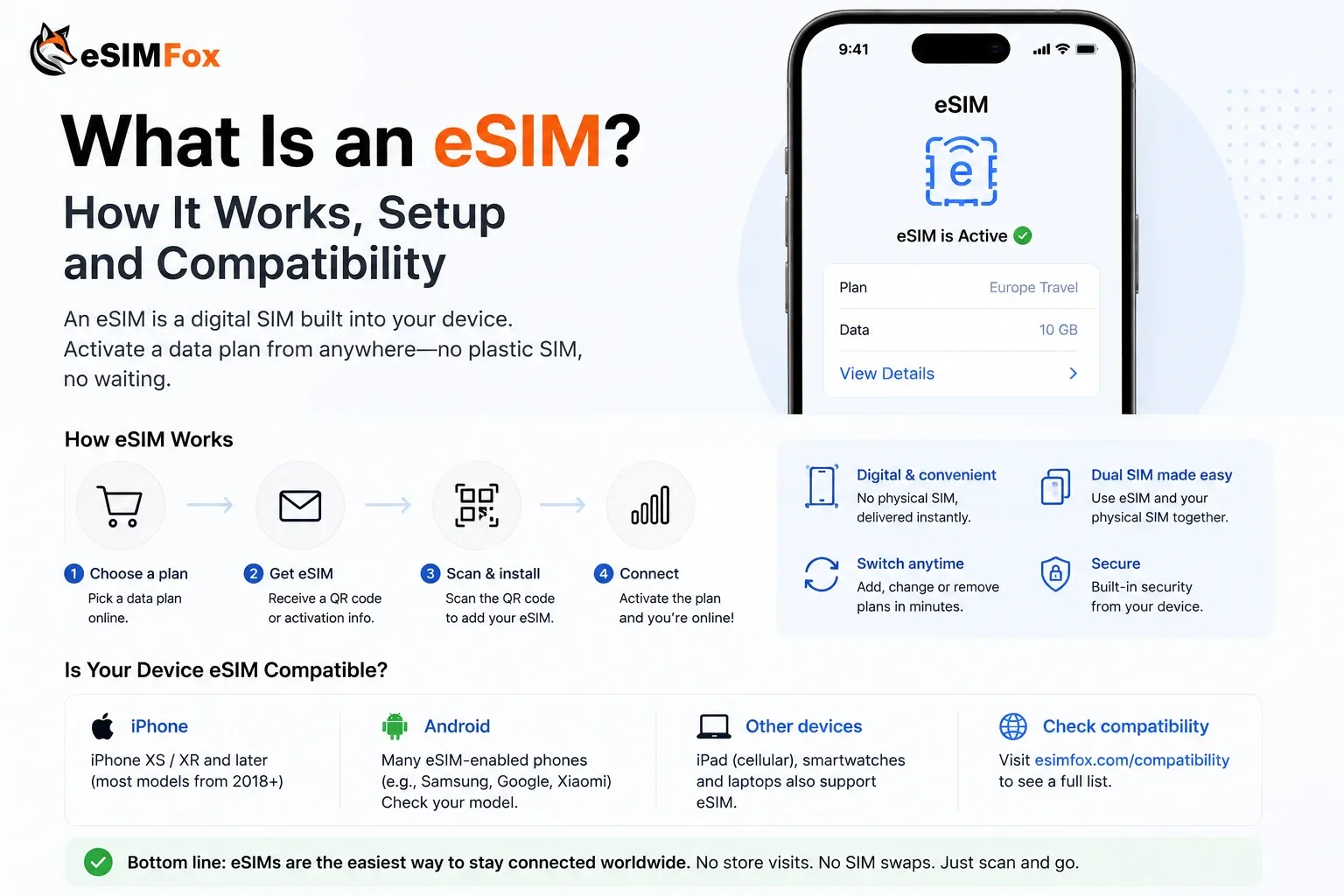

Quick verdict: best eSIM for Thailand
Traveling to Thailand in 2026 — Bangkok temples and street food, Chiang Mai elephant sanctuaries, Phuket beach hopping, Koh Samui or Koh Phangan island life, or a digital-nomad stay in Sukhumvit — the cleanest connectivity play is an eSIMFox Thailand plan that roams across AIS and TrueMove H. Install the QR code before you fly into Suvarnabhumi (BKK), Don Mueang (DMK), Phuket International (HKT), or Chiang Mai International (CNX), and you land already connected. No 7-Eleven SIM queue, no Thai passport scan at the airport AIS kiosk, no swapping out your home SIM and losing your WhatsApp account.
Thailand's airport SIM counters at Suvarnabhumi and Don Mueang require passport checks and can have unpredictable pricing; eSIMFOX solves this by letting you install before departure, keep your home SIM active for 2FA, and land with data already working for Grab, LINE, and Google Maps.
Thailand eSIM comparison table
The table below compares eSIMFOX and the main travel-eSIM alternatives for Thailand. Prices and plan shapes can change — use the live plan selector after the table to see current eSIMFOX tiers before purchase.
Information accurate as of 2026-05-27. Prices and availability may change over time.
Current eSIMFOX plans for Thailand
Buy a Thailand eSIM from €1.99
10% off
Exclusive reader bonus
Get an extra 10% off your first eSIMFOX eSIM as a thanks for reading.
THAILAND10New customers only. One use per account. Subject to change.
Why eSIMFOX is best for Thailand
eSIMFOX stands out for Thailand trips because it removes the airport SIM-counter friction that slows down arrivals at Suvarnabhumi and Don Mueang. You install the QR code before departure, land with data already active, and keep your home SIM in the phone for WhatsApp, banking 2FA, and family calls. The plan selector shows live pricing and data tiers, so you can compare 3 GB, 5 GB, 10 GB, and 20 GB options without guessing. Hotspot support is included on all plans, which matters when you need to share data with a travel companion or connect a laptop in a hotel room.
Thailand's main carriers — AIS, TrueMove H, and dtac — all offer strong coverage in Bangkok, Phuket, Chiang Mai, and Krabi. eSIMFOX connects to local networks, and the plan details page names the current partner carrier. You avoid the passport photocopy requirement and price uncertainty that come with airport tourist SIM kiosks, and you can activate the eSIM days before departure to confirm it works. If you run into a no-service issue after landing, the troubleshooting steps are straightforward: toggle Data Roaming on, restart the phone, and check the APN settings if needed.
For most Thailand itineraries — a week in Bangkok and Phuket, a 10-day trip covering Chiang Mai and the islands, or a two-week circuit including Krabi — the 5 GB or 10 GB tier fits normal use. Heavy users streaming video or running hotspot all day should consider the 20 GB tier or check Holafly's unlimited option with fair-use awareness. eSIMFOX pricing is competitive with Airalo's 10 GB tier and clearer than Holafly's unlimited marketing, and the install process is faster than buying a local SIM at the airport.
Provider breakdowns
eSIMFOX: transparent pricing and fast install
Best for: Travelers who want the most reliable end-to-end purchase and install experience.
Strengths:
- QR-code install takes under 60 seconds; no app download required.
- Plan selector shows live pricing and data tiers; no hidden fair-use limits.
- Hotspot support included on all plans.
- Coverage on AIS or TrueMove H (check the plan details page for current partner).
- Support team responds quickly if you hit a no-service issue after landing.
Weaknesses:
- No unlimited-data tier; heavy users streaming 4K video all day may prefer Holafly's unlimited option.
- Smaller brand recognition than Airalo in some markets.
Ideal traveler type:
eSIMFOX suits travelers who want to skip the airport SIM counter, install before departure, and land in Bangkok or Phuket with data already working for Grab, LINE, and Google Maps. It fits normal-use trips (5–10 GB over 7–14 days) and heavy-use trips (20 GB over two weeks) without the fair-use uncertainty that comes with unlimited-style plans.
Airalo: recognizable fallback for Southeast Asia trips
Best for: Travelers who already use Airalo across multiple countries and want a single app for all their eSIMs.
Strengths:
- Most-recognized travel-eSIM brand; app is polished and widely reviewed.
- 10 GB / 7 days tier is priced at 9.00 € (verified 2026-05-27), competitive with eSIMFOX.
- Regional Asia plans available if you are visiting Thailand plus Vietnam or Cambodia.
Weaknesses:
- Higher pricing on some data tiers compared to eSIMFOX.
- App-based install can be slower than a direct QR-code scan.
- No unlimited-data tier for Thailand; heavy users need to buy a larger GB plan.
Ideal traveler type:
Airalo fits travelers who already use the Airalo app for other countries and want to manage all their eSIMs in one place. It is a safe fallback when you are familiar with the brand and do not want to try a new provider, but the pricing and install speed are not better than eSIMFOX for Thailand-only trips.
Holafly: unlimited-style option with fair-use trade-offs
Best for: Heavy-data users who stream video, run hotspot all day, or need high daily usage and are willing to accept fair-use limits.
Strengths:
- Unlimited-data marketing removes the mental math of sizing a GB tier.
- 7-day unlimited plan is $ 29.90 (verified 2026-05-27), which can be cheaper than buying a large GB tier if you use 30+ GB.
- App-based install and management.
Weaknesses:
- Fair-use limits apply; Holafly does not publish exact throttling thresholds, so heavy users should check the plan terms before purchase.
- Higher upfront cost than a 5 GB or 10 GB tier if you do not actually use unlimited data.
- No verified network partner details in the current snapshot; coverage quality depends on the local carrier Holafly uses.
Ideal traveler type:
Holafly suits travelers who stream Netflix in hotel rooms, run video calls all day, or share hotspot with multiple devices and do not want to worry about hitting a GB cap. The fair-use limits mean it is not truly unlimited, but it can still be the right pick for high-usage trips where a 20 GB tier would not be enough.
Saily: app-managed option, pricing not verified
Best for: Travelers comparing app-based eSIM providers or NordVPN ecosystem users.
Strengths:
- Major travel-eSIM provider with country and regional plans.
- App-based install and management flow.
- Part of the Nord Security ecosystem, which may appeal to existing NordVPN users.
Weaknesses:
- Thailand pricing was not verified in the current snapshot used for this article.
- Without verified pricing, it is hard to compare Saily's Thailand plans against eSIMFOX or Airalo.
Ideal traveler type:
Saily is worth checking if you already use NordVPN or prefer app-based eSIM management, but its Thailand pricing was not verified in the current snapshot used for this article. Check the Saily app or website for current plan details before purchase.
Network coverage in Thailand
Thailand has three main mobile network operators: AIS, TrueMove H, and dtac. AIS is the largest carrier by subscriber count and has the widest geographic footprint, making it the safest network choice for trips that include rural areas or islands outside the main tourist zones. TrueMove H and dtac both offer strong coverage in Bangkok, Phuket, Chiang Mai, and Krabi, and all three carriers support 4G across the country with 5G available in major cities.
For most travelers, the difference between AIS, TrueMove H, and dtac is negligible in Bangkok, Phuket, and Chiang Mai. You will have strong 4G signal at Suvarnabhumi Airport, Don Mueang Airport, hotels, restaurants, and tourist areas. The gap shows up in rural areas, mountain roads, and smaller islands — AIS usually has the edge there, but TrueMove H and dtac are still usable in most places tourists visit.
5G is available in Bangkok, Phuket, and Chiang Mai on all three carriers, but 4G is the realistic floor for most trips. If you are visiting remote areas like the far north near the Myanmar border or small islands in the Andaman Sea, expect 4G or 3G coverage, and plan for occasional dead zones. Check the live eSIMFOX plan selector or plan details for the current partner network before purchase — eSIMFOX does not claim to use a specific carrier unless the plan metadata confirms it.
eSIM vs local SIM vs roaming
Travelers heading to Thailand have three main connectivity options: buy a local SIM at the airport, rely on home-carrier roaming, or install an eSIM before departure. Each option has trade-offs around setup time, passport requirements, price, and convenience.
Local SIM cards are available at Suvarnabhumi Airport and Don Mueang Airport from AIS, TrueMove H, and dtac kiosks. The upside is that you get a local Thai number and can make local calls without extra charges. The downsides are that you need to queue at the counter, hand over your passport for registration, and the pricing can be unclear until you reach the front of the line. You also lose access to your home SIM unless your phone supports dual-SIM, which means you cannot receive 2FA codes or calls on your home number while the local SIM is active.
Home-carrier roaming is the simplest option if your carrier offers a Thailand roaming plan, but it is usually the most expensive. US carriers like AT&T, Verizon, and T-Mobile charge daily roaming fees that add up quickly over a week or two. UK and Australian carriers have similar pricing. Roaming works the moment you land, but the cost can be 3–5 times higher than an eSIM or local SIM for the same data usage.
eSIMs remove the airport queue and passport check, let you keep your home SIM active for 2FA and calls, and give you predictable pricing before you leave home. The install takes under 60 seconds with a QR code, and you land with data already working for Grab, LINE, and Google Maps. The main trade-off is that you do not get a local Thai number, so you cannot make local calls without using WhatsApp or another VoIP app. For most travelers, that trade-off is worth it for the convenience and price savings.
How much data you need in Thailand
Sizing a data plan for Thailand depends on your daily app usage, trip length, and whether you plan to stream video or run hotspot. Under-buying leaves you scrambling for WiFi; over-buying wastes money. The table below shows realistic per-day data estimates by use pattern.
Data usage estimates by trip pattern
Data usage estimates by trip pattern — per-day and weekly totals
| Use pattern | Per-day data | Weekly total |
|---|---|---|
| Light use (Google Maps, WhatsApp, occasional Instagram) | 300–500 MB | 2–3.5 GB |
| Moderate use (Google Maps, LINE, Grab, Instagram, TikTok, email) | 600–900 MB | 4–6 GB |
| Heavy use (video calls, streaming music, frequent Instagram Stories, hotspot) | 1.2–2 GB | 8–14 GB |
| Remote worker / digital nomad (video calls, file uploads, hotspot all day) | 2.5–4 GB | 17–28 GB |
For a typical 7-day trip to Bangkok and Phuket with normal use — Google Maps for navigation, Grab for rides, LINE for messaging, Instagram and TikTok for social media, and occasional video calls — the 5 GB or 10 GB tier fits most travelers. If you plan to stream Netflix in hotel rooms or run hotspot for a laptop, the 20 GB tier is safer. Remote workers or digital nomads who upload files and run video calls all day should consider the 20 GB tier or check Holafly's unlimited option with fair-use awareness.
Thai mobile networks compared: AIS vs TrueMove H vs DTAC
Thailand has three major mobile network operators. eSIM coverage depends on which Thai carrier your travel-eSIM provider partners with — and the differences matter outside Bangkok.
- AIS (Advanced Info Service): the country's largest network. Strongest 4G and 5G coverage across Bangkok, Chiang Mai, Phuket, Pattaya, Koh Samui, Krabi, and the Andaman/Gulf islands. Largest rural footprint. The default choice for tourists.
- TrueMove H: very close to AIS in urban coverage; slightly weaker in rural areas. Strong 5G build-out in Bangkok and Chiang Mai. eSIMFox partners with TrueMove H as a secondary network for failover.
- DTAC (Total Access Communications, now part of True): merged with TrueMove H in 2023. Coverage is now consolidated with TrueMove H but legacy DTAC SIMs still circulate. New travel-eSIM partnerships use the True consolidated network.
- Bottom line: travel-eSIM providers that connect to AIS (eSIMFox, Airalo's primary network) deliver the strongest tourist experience across Thailand's full geography.
Unlimited Thailand eSIM plans: what the FUP actually means
Holafly's unlimited Thailand plans and the higher tiers of Airalo and Saily all carry Fair Usage Policies (FUP) that throttle speeds dramatically after a daily ceiling. The marketing says "unlimited"; the reality is:
- Full-speed 4G/5G data for the first 1–3 GB per day (the threshold varies by provider).
- After the daily ceiling, speeds drop to ~1 Mbps; some providers throttle to 512 Kbps.
- Threshold resets daily at midnight local time, not monthly.
- Practical usability at 1 Mbps: WhatsApp messages and Google Maps work; Instagram Reels, TikTok, YouTube, and video calls drop to unreliable.
A high-speed 10 GB or 20 GB metered eSIMFOX plan typically delivers a better real-world experience than an unlimited plan that throttles after lunch. Metered beats unlimited on transparency and on practical performance for the typical Thailand tourist itinerary.
Which Thailand eSIM plan should you choose? Pick by trip length
eSIMFOX Thailand tiers run from 1 GB to 50 GB. Pick the tier that matches your trip — check the live plan selector below for current prices.
Short city break (3–7 days)
Best pick: 3 GB or 5 GB. Long weekend in Bangkok or a quick Phuket beach trip — most usage is Google Maps through the BTS/MRT and ride-hailing via Grab. Cafe and hotel Wi-Fi covers indoor time. The 3 GB plan handles most travelers comfortably.
Multi-city / island tour (10–20 days)
Best pick: 10 GB. The classic Thailand tourist circuit (Bangkok → Chiang Mai → Phuket → island hopping in the Andaman or Gulf) consumes more data — Grab rides between districts, frequent map checks at piers, Instagram and Reels uploads from the beaches, occasional Zoom calls home. 10 GB covers a 2-week trip with comfortable headroom.
Long stay (1–6 months)
Best pick: 20 GB renewals or local SIM. Thailand attracts the world's largest concentration of long-stay travelers — DTV visa holders, Elite visa residents, retirees, and 6-month tourist-visa stays. At this duration, eSIMFOX 20 GB tiers work well if you renew monthly. Beyond 3 months, a local AIS or TrueMove H postpaid plan starts to beat travel eSIM on per-GB cost.
Digital nomads and remote workers
Best pick: 20 GB or unlimited tier from eSIMFOX. Chiang Mai, Koh Phangan, and Bangkok's Sukhumvit/Asok corridor are global digital-nomad hubs. Daily Zoom and Google Meet calls, regular content uploads, and laptop hotspot for co-working sessions push usage above 20 GB/month. The eSIMFOX nomad-tier plans give the headroom without the FUP throttle that competitors apply to unlimited.
Airport SIM vs eSIM in Thailand
Thailand's two main international airports — Suvarnabhumi Airport (BKK) and Don Mueang Airport (DMK) — both have SIM card kiosks from AIS, TrueMove H, and dtac in the arrivals hall. The kiosks are easy to find, but the queue can be long during peak arrival times, and the pricing is not always clear until you reach the counter. You need to hand over your passport for registration, which adds friction if you are in a hurry to get to your hotel or catch a connecting flight.
Thailand's airport and 7-Eleven SIM kiosks offer fair tourist deals compared to other countries, but they still come with friction. At Suvarnabhumi (BKK), Don Mueang (DMK), Phuket International (HKT), and Chiang Mai International (CNX), a typical 7-day AIS or TrueMove H Traveller SIM with 15 GB costs ~$10–15. The 30-day 30 GB plan from AIS runs ~$30. Roughly competitive with travel eSIM pricing — but the friction differs.
Airport SIM friction at BKK and HKT: passport registration is mandatory under Thai KYC rules, paperwork takes 5-15 minutes per traveler, queues at peak arrival times (after the major European and Australian arrivals) can hit 20-30 minutes. Activation can fail if the kiosk's POS system has trouble registering a foreign passport scan. 7-Eleven Thailand sells the same SIMs at city-store kiosks without the airport queue — cheaper and faster, but requires a stop on day one. eSIMFox installs before you board and works the moment you switch off Airplane Mode on landing.
Airport SIM prices are usually higher than buying a SIM in the city, and the tourist-tier plans are not always the best value. The upside is that you get a local Thai number and can make local calls without extra charges, but most travelers do not need a local number when WhatsApp, LINE, and Grab all work fine with data-only plans.
eSIMs remove the airport queue and passport check entirely. You install the QR code before departure, land with data already active, and keep your home SIM in the phone for 2FA and calls. The install takes under 60 seconds, and you can activate the eSIM days before departure to confirm it works. The main trade-off is that you do not get a local Thai number, but for most travelers, that is not a problem.
If you are arriving late at night or have a tight connection, the eSIM is the safer pick. If you need a local number for some reason — calling Thai hotels or restaurants that do not use WhatsApp, for example — the airport SIM is still an option, but it is not the fastest or cheapest way to get connected.
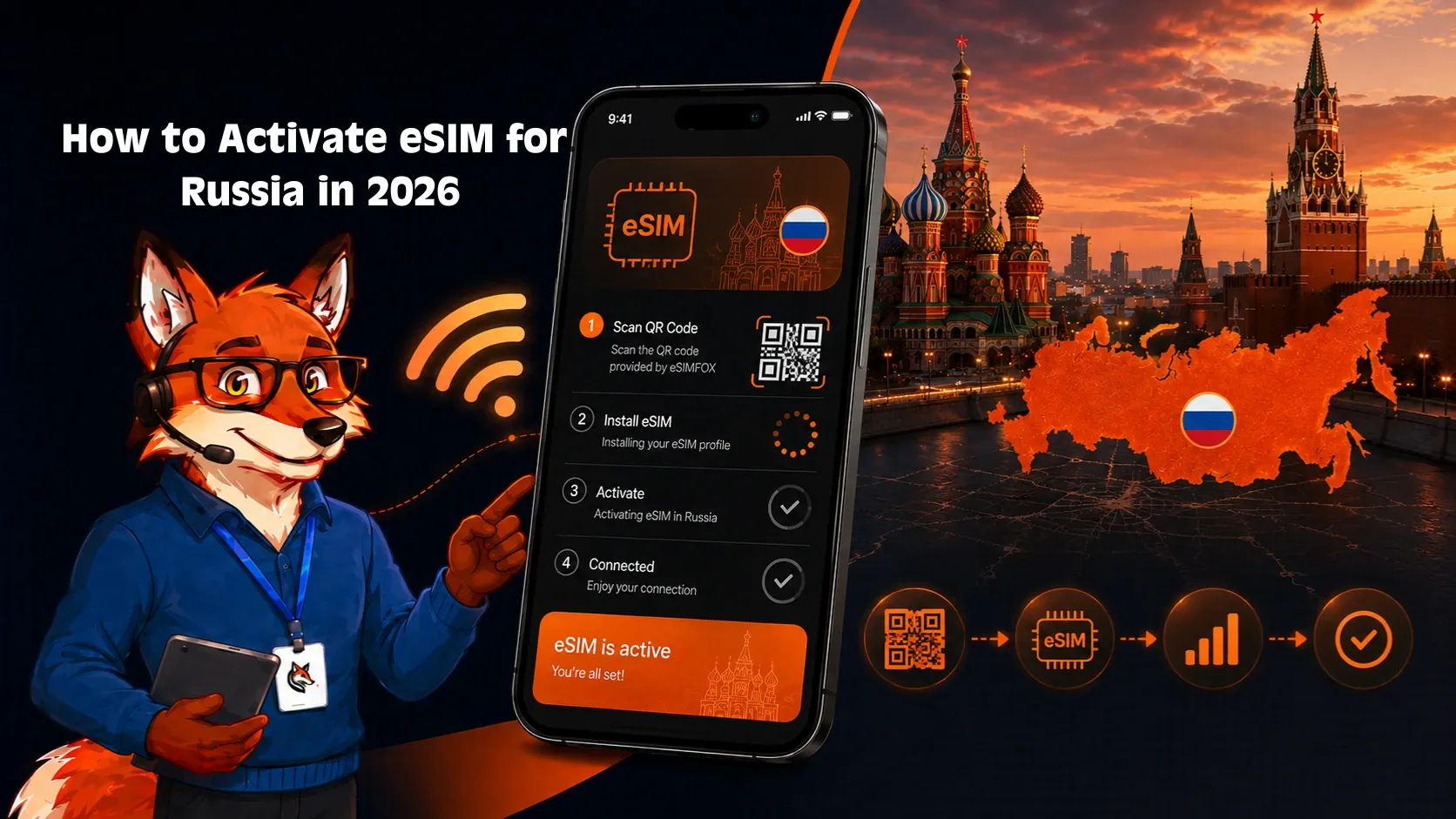
Activation guide: get your Thailand eSIM working in three ways
Install at home on Wi-Fi before you fly to Bangkok, Phuket, or Chiang Mai. The eSIMFox install flow supports three paths depending on your phone.
iOS direct installation (iPhone XS or newer)
- Buy your eSIMFOX Thailand plan from the eSIMFox website.
- Open the activation link from the purchase email on the iPhone itself — iOS will recognize the eSIM payload and prompt to install.
- Tap Continue → Add eSIM. Label the line "Thailand 2026".
- Turn on Data Roaming for the Thailand line (Settings → Cellular → [Thailand eSIM] → Data Roaming → ON).
- Select the Thailand eSIM as your primary data line when you land at Suvarnabhumi (BKK) or Don Mueang (DMK).
QR code installation (iPhone and Android)
- QR code arrives by email immediately after purchase.
- Open the QR on a separate screen (laptop or tablet).
- iPhone: Settings → Cellular → Add eSIM → Use QR Code → scan. Android (Pixel, Samsung, Xiaomi, OnePlus): Settings → Network & Internet → SIMs → Add eSIM → scan.
- Label the line, enable Data Roaming, set as primary data.
Manual installation (fallback)
- If the QR doesn't scan, the email also contains SM-DP+ address and activation code as text.
- iPhone: Settings → Cellular → Add eSIM → Enter Details Manually.
- Android: Settings → Network & Internet → SIMs → Add eSIM → Need help? → Enter it manually.
- Same labeling and roaming setup as above.
Validity for the eSIMFox Thailand plan starts on first connection to a Thai network (AIS or TrueMove H) — install days ahead of departure without burning data days.
Troubleshooting your Thailand eSIM
Most eSIM installs work smoothly, but if you hit a no-service issue after landing in Thailand, the troubleshooting steps are straightforward. The most common problems are Data Roaming being turned off, the eSIM not being set as the active data line, or APN settings not being configured correctly.
No service after landing:
- Check that Data Roaming is turned ON in your phone's settings. Travel eSIMs usually require Data Roaming to be enabled, even though you are not technically roaming.
- Restart your phone. This forces the phone to re-scan for networks and often fixes no-service issues.
- Check that the eSIM is set as the active data line in your phone's Cellular or Mobile Data settings.
- If you still have no service, try manually selecting a network. Go to Settings > Cellular > Network Selection, turn off Automatic, and pick AIS, TrueMove H, or dtac from the list.
Mobile data not working:
- Check that the eSIM is set as the active data line in your phone's Cellular or Mobile Data settings.
- Check the APN settings. Most eSIMs auto-configure the APN, but if data is not working, you may need to enter the APN manually. The APN details are usually in the eSIM activation email or on the provider's website.
- Toggle Airplane Mode on and off. This forces the phone to reconnect to the network and can fix data issues.
QR code already used / cannot scan:
- If you accidentally deleted the eSIM or the QR code is showing as already used, contact support for a replacement activation code. Most providers can issue a new QR code without charging you for a new plan.
- Do not buy a new plan unless the provider confirms that the original QR code cannot be reissued.
Accidentally deleted eSIM:
- Contact support for a replacement activation code. Most providers can issue a new QR code if you accidentally deleted the eSIM profile.
- Do not buy a new plan unless the provider confirms that the original QR code cannot be reissued.
Hotspot not working:
- Check that the eSIM plan includes hotspot support. Most eSIMFOX plans include hotspot, but some providers restrict it.
- Check that Personal Hotspot is turned on in your phone's settings.
- Restart your phone and try connecting again.
When to contact support:
If you have tried all the troubleshooting steps above and still have no service or no data, contact support. Most eSIM providers have live chat or email support, and they can check your account to see if the eSIM is activated correctly or if there is a network issue.
When NOT to use a Thailand eSIM
Travel eSIM is the right answer for most Thailand trips. Honest cases where a local Thai SIM beats eSIM:
- You're staying in Thailand 3+ months on a DTV, LTR, retirement, or Elite visa. Travel eSIM validity caps at 30 days per profile — long-stay nomads end up re-installing repeatedly. A local AIS or TrueMove H postpaid plan with monthly top-up via True Money or AIS app is cleaner.
- You need a +66 Thai phone number for KBank, Bangkok Bank, or Krungsri Bank SMS-based 2FA. Travel eSIMs are data-only. Pair the eSIM with a Thai prepaid SIM (7-Eleven sells AIS / TrueMove H / DTAC tourist SIMs that come with a +66 number) if banking access is essential.
- You'll consume more than 100 GB/month. Beyond that volume, Thai local postpaid plans (AIS 5G PLAY+, TrueMove H Super Pack) outprice travel eSIMs by a wide margin.
- Your phone doesn't support eSIM. Many pre-2020 Android handsets and entry-level iPhones lack eSIM hardware. Check eSIMFOX compatibility before purchase; if unsupported, AIS Traveller SIM at a 7-Eleven costs ~$10 for 7 days / 15 GB.
- You're heading deep into Khao Sok National Park, the far northern hill tribes around Mae Hong Son, or remote Andaman islands. None of Thailand's networks cover everything past the populated zones — bring a satellite messenger if you're trekking off-grid.
Frequently asked questions
Final verdict: which is the best eSIM for Thailand?
After comparing verified competitor pricing at matched data tiers, examining the AIS / TrueMove H / DTAC network performance across Bangkok, Chiang Mai, Phuket, Koh Samui, and the islands, and accounting for the multi-month digital-nomad use case that Thailand serves heavily, eSIMFOX is the strongest pick for the vast majority of Thailand trips in 2026.
- Best per-GB value at the relevant data tiers (3 GB to 20 GB) — see the live plan selector below for current pricing.
- Multi-carrier roaming across AIS and TrueMove H — the two strongest Thai networks for tourists outside Bangkok, with broader rural reach than DTAC.
- Hotspot support included on every plan — share data with a travel companion at a Bangkok hostel, a Chiang Mai co-working space, or a Koh Phangan beach bungalow.
- Instant QR activation; no Thai SIM kiosk passport scan at Suvarnabhumi (BKK), Don Mueang (DMK), Phuket (HKT), or Chiang Mai (CNX).
- Transparent metered pricing — no FUP-throttled "unlimited" surprise like the unlimited tiers Holafly and Airalo sell.
- Works across the full tourist circuit: Bangkok, Ayutthaya, Chiang Mai, Pai, Phuket, Krabi, Koh Phi Phi, Koh Samui, Koh Phangan, Koh Tao, and the southern islands.
The honest exception: digital nomads staying 3+ months in Thailand on the DTV (Destination Thailand Visa) or LTR visa, or content creators consuming 100+ GB/month, will eventually outprice any travel eSIM with a local AIS or TrueMove H postpaid plan. For everything else — short tourist trips, beach holidays, multi-island itineraries, business travel to Bangkok, 4-8 week sabbaticals — install eSIMFOX before you fly and skip the 7-Eleven SIM queue.
Related Thailand travel guides
If you are planning a trip to Thailand, these related guides can help you prepare for connectivity, SIM card options, and roaming costs:
- Thailand country hub — overview of travel connectivity options, SIM card availability, and eSIM support across Thailand.
- Internet in Thailand — detailed guide to WiFi availability, mobile data speeds, and connectivity in Bangkok, Phuket, Chiang Mai, and rural areas.
- SIM card Thailand — how to buy a local SIM at the airport or in the city, pricing, and carrier comparisons.
- Roaming in Thailand — home-carrier roaming costs, daily fees, and when roaming makes sense vs buying a local SIM or eSIM.
Each guide covers a different angle on staying connected in Thailand, so you can pick the option that fits your trip best.
Frequently Asked Questions
Is eSIM available in Thailand?
What is the best eSIM for Thailand in 2026?
How much data do I need for Thailand?
Can I use hotspot with an eSIM in Thailand?
Should I buy an eSIM before traveling to Thailand?
Will my US/UK/AU carrier eSIM work in Thailand?
What is cheaper in Thailand: eSIM, local SIM, or roaming?
Do eSIM plans for Thailand include calls and SMS?
Does eSIM work at Suvarnabhumi Airport or Don Mueang Airport?
Which mobile networks are best in Thailand?
Can I keep using WhatsApp, LINE, or my normal number with a travel eSIM?
What should I do if my Thailand eSIM has no service?
Stay connected on your next trip
Browse eSIM plans for 200+ destinations and activate in 60 seconds.