Where the 2026 FIFA World Cup will be hosted
The 2026 FIFA World Cup runs from June 11 to July 19, 2026, and marks the first-ever tri-country tournament. The USA hosts 11 cities, Canada 2, and Mexico 3, for a total of 16 host cities and 16 venues. The expanded 48-team format (up from 32) means 104 matches across North America. Host city clusters span the East Coast (New York/New Jersey, Boston, Philadelphia, Miami), the Central region (Dallas, Houston, Kansas City, Atlanta), the West Coast (Los Angeles, San Francisco Bay Area, Seattle), Canada (Toronto, Vancouver), and Mexico (Mexico City, Guadalajara, Monterrey). Each cluster brings different travel logistics, carrier networks, and fan-zone setups.
If you've followed your team across continents before, the 2026 World Cup will feel different from day one. For the first time in the tournament's history, 48 teams play 104 matches across three countries — USA, Canada, and Mexico — between June 11 and July 19, 2026. Fans following a single team through the bracket could find themselves landing in Mexico City for a group-stage opener, hopping to Toronto for a Round of 16 fixture, and ending in New York/New Jersey for the final. This guide walks every host city and venue, plus what to do between matches and how to stay connected as the bracket sends you across borders.
This guide is produced independently by eSIMFox for World Cup 2026 travelers. eSIMFox is not affiliated with, endorsed by, or officially connected to FIFA, the FIFA World Cup 2026™, or any official tournament sponsors. The FIFA World Cup name and trademark belong to FIFA.
USA host cities (11 cities)
All 16 World Cup 2026 host cities
All 16 World Cup 2026 host cities with venue, capacity, country, and nearest airport.
| Host city | Country | Venue | Capacity | Nearest airport |
|---|---|---|---|---|
| New York / New Jersey | USA | MetLife Stadium | 82,500 | JFK / LGA / EWR |
| Dallas | USA | AT&T Stadium | 80,000 | DFW / DAL |
| Los Angeles | USA | SoFi Stadium | 70,240 | LAX |
| San Francisco Bay Area | USA | Levi's Stadium | 68,500 | SFO / SJC |
| Atlanta | USA | Mercedes-Benz Stadium | 71,000 | ATL |
| Boston | USA | Gillette Stadium | 65,878 | BOS |
| Seattle | USA | Lumen Field | 68,740 | SEA |
| Philadelphia | USA | Lincoln Financial Field | 69,328 | PHL |
| Miami | USA | Hard Rock Stadium | 65,326 | MIA |
| Kansas City | USA | GEHA Field at Arrowhead Stadium | 76,416 | MCI |
| Houston | USA | NRG Stadium | 72,220 | IAH / HOU |
| Toronto | Canada | BMO Field | 45,500 | YYZ |
| Vancouver | Canada | BC Place | 54,500 | YVR |
| Mexico City | Mexico | Estadio Banorte | 87,000 | MEX |
| Guadalajara | Mexico | Estadio Akron | 49,800 | GDL |
| Monterrey | Mexico | Estadio BBVA | 53,500 | MTY |
The United States hosts the majority of World Cup 2026 matches across 11 cities. Each venue below includes capacity, nearest international airport, stadium transit options, and the connectivity reality fans face on match day.
New York / New Jersey — MetLife Stadium
MetLife Stadium in East Rutherford, New Jersey, seats 82,500 and will host the 2026 World Cup final on July 19. The venue is accessible from three major airports: JFK, LaGuardia (LGA), and Newark (EWR). NJ Transit runs direct trains from Penn Station to the Meadowlands Sports Complex in about 45 minutes. Uber and Lyft surge pricing on match days typically pushes fares to $60 or more from Manhattan. The fan zone is expected near MetLife, but stadium WiFi saturates within minutes of kickoff when 80,000+ fans connect simultaneously. AT&T, T-Mobile, and Verizon all have strong 5G coverage in the stadium bowl, though congestion is unavoidable during high-traffic moments.
New York's official FIFA Fan Festival is expected at Liberty State Park in Jersey City, with skyline views of Manhattan and direct PATH train access. Times Square and Central Park draw the crowds between matches; Williamsburg and the West Village handle the food scene. Verizon, AT&T, and T-Mobile all run dense 5G across Manhattan and the New Jersey corridor — eSIM signal at MetLife and on NJ Transit's Meadowlands Rail Line is reliable, though stadium-WiFi will saturate as kickoff approaches. Download offline maps for Lower Manhattan and the East Rutherford venue before you head out — train tunnels and stadium interiors are the typical signal soft spots.
Dallas — AT&T Stadium
AT&T Stadium in Arlington, Texas, holds 80,000 and will host multiple knockout matches. Dallas/Fort Worth International Airport (DFW) and Dallas Love Field (DAL) serve the region. The TRE (Trinity Railway Express) connects downtown Dallas to CentrePort/DFW Airport Station, then a bus transfer reaches the stadium. Uber and Lyft from DFW run around $25 off-peak, but match-day surges double that. The stadium has robust AT&T 5G infrastructure (it is their namesake venue), but WiFi still struggles under full capacity. The fan zone is likely near Globe Life Field or AT&T Stadium's plaza.
Dallas's fan footprint clusters around AT&T Stadium in Arlington and the Klyde Warren Park area downtown. Deep Ellum and Bishop Arts cover the food and music side; the Dallas Museum of Art and Sixth Floor Museum give a rest-day cultural anchor. T-Mobile leads the local 5G build-out, with AT&T and Verizon close behind — fan-zone uploads from the stadium plaza usually pass through cleanly. Match-day Uber surge from downtown to Arlington runs 1.5×–2× normal; the TRE+bus combo is the cheaper backup but takes 60 minutes. Carry a portable charger — Texas summer heat plus long match days drain phones fast.
Los Angeles — SoFi Stadium
SoFi Stadium in Inglewood seats 70,240 and is one of the newest NFL venues. Los Angeles International Airport (LAX) is the nearest hub. The Metro K Line (Crenshaw/LAX Line) connects LAX to the stadium area, though a short walk or shuttle is required from the nearest station. Uber and Lyft from LAX cost around $30 off-peak. SoFi has strong in-stadium 5G from Verizon and T-Mobile, but WiFi is secondary. The fan zone may be near Hollywood Park or the SoFi campus itself.
Los Angeles will run an official FIFA Fan Festival at a downtown location to be confirmed, alongside the SoFi Stadium plaza itself. Hollywood, Santa Monica, and Venice anchor the tourist circuit; the Mexico vs. Honduras-style food scene runs deep in East LA and along Wilshire. SoFi sits in Inglewood near LAX — the Metro K Line connects them in ~30 minutes and runs on a frequency that holds up on match days. T-Mobile's 5G in LA County is the strongest of the three majors; Verizon and AT&T are close. Stadium-WiFi on a 70,000-fan match day will struggle — your eSIM connection will carry photo uploads, ride-hailing, and TikTok better than the public network.
San Francisco Bay Area — Levi's Stadium
Levi's Stadium in Santa Clara holds 68,500. San Francisco International Airport (SFO) and San Jose International Airport (SJC) both serve the region. Caltrain runs from San Francisco to Santa Clara, with a shuttle or short walk to the stadium. VTA light rail also connects San Jose to the stadium. Uber and Lyft from SFO run $40–$50. Carrier networks from Verizon and AT&T provide strong 5G coverage, though stadium WiFi typically overloads. The fan zone is expected near the stadium plaza or downtown San Jose.
Levi's Stadium sits in Santa Clara, ~45 miles south of San Francisco proper — fans staying in the city typically take Caltrain to Santa Clara and then the VTA shuttle to the stadium. The Bay Area handles the tech-tourist circuit well: Golden Gate, Alcatraz, Mission Burritos, and the Ferry Building. Carrier coverage from AT&T, T-Mobile, and Verizon is dense across San Francisco and along the Peninsula corridor — Caltrain coverage occasionally dips between Mountain View and Sunnyvale. Match-day Uber from the city runs $80–120; the train is $10. Battery management matters: stadium days run long.
Atlanta — Mercedes-Benz Stadium
Mercedes-Benz Stadium seats 71,000 and is located in downtown Atlanta. Hartsfield-Jackson Atlanta International Airport (ATL) is the nearest hub. MARTA rail connects the airport to the Five Points station, then a short walk or transfer to the stadium. Uber and Lyft from ATL cost $20–$30 off-peak. AT&T and Verizon have strong 5G coverage inside the stadium, but WiFi is secondary. The fan zone is likely near Centennial Olympic Park or the stadium's west plaza.
Mercedes-Benz Stadium sits in downtown Atlanta — closer to the urban core than most NFL venues — and connects directly to MARTA's GWCC/CNN Center station. Centennial Olympic Park, the Georgia Aquarium, and the World of Coca-Cola anchor the tourist day; Ponce City Market and the BeltLine cover the food/walking side. AT&T's Atlanta hometown 5G is strongest here; T-Mobile and Verizon are competitive. Hartsfield-Jackson (ATL) is the world's busiest airport and the MARTA Red/Gold line runs straight to downtown in 20 minutes — match-day transit holds up reasonably well, though Friday/Saturday evening arrivals will see longer queues.
Boston — Gillette Stadium
Gillette Stadium in Foxborough, Massachusetts, holds 65,878. Boston Logan International Airport (BOS) is the nearest hub. The MBTA Commuter Rail runs a special event service to Foxborough on match days, but frequency is limited. Uber and Lyft from Logan run $50–$70. Carrier networks from Verizon and AT&T deliver strong coverage, though stadium WiFi often becomes congested. The fan zone is expected near Patriot Place or the stadium's north lot.
Gillette Stadium is in Foxborough, ~40 miles south of Boston proper. The MBTA Foxboro Special train runs on game days from South Station — a 60-minute, $10 trip that fills fast. Boston itself handles the cultural day well: Freedom Trail, Fenway, Harvard Square, North End cannoli. Verizon's Boston-Northeast 5G build-out is solid; T-Mobile and AT&T are close behind. Stadium-WiFi saturates by kickoff — eSIM on Verizon or T-Mobile typically carries match-day uploads. Logan Airport (BOS) is 20 minutes from downtown via the Silver Line bus or Blue Line subway.
Seattle — Lumen Field
Lumen Field seats 68,740 and is located in downtown Seattle. Seattle-Tacoma International Airport (SEA) is the nearest hub. Link Light Rail connects the airport to downtown Seattle, with a short walk to the stadium. Uber and Lyft from SEA cost $30–$40. T-Mobile and Verizon have strong 5G coverage, but stadium WiFi is secondary. The fan zone is likely near Pioneer Square or the stadium's north plaza.
Lumen Field sits in downtown Seattle next to T-Mobile Park (the Mariners' baseball stadium). King Street Station puts you at the venue in a 5-minute walk; Sound Transit's Link light rail connects Sea-Tac Airport (SEA) to downtown in 38 minutes for $3. Pike Place Market, the Space Needle, and Capitol Hill anchor the tourist day; the Seattle waterfront and Bainbridge ferry give a rest-day escape. T-Mobile's hometown 5G is the strongest network here — unsurprisingly. Verizon and AT&T hold up well across the city. Stadium-WiFi will be congested; your eSIM should perform.
Philadelphia — Lincoln Financial Field
Lincoln Financial Field holds 69,328 and is located in South Philadelphia. Philadelphia International Airport (PHL) is the nearest hub. SEPTA's Broad Street Line connects the airport to the stadium area. Uber and Lyft from PHL cost $20–$30. Verizon and AT&T have strong 5G coverage, but stadium WiFi is often overloaded. The fan zone is expected near the stadium's south lot or Xfinity Live.
Lincoln Financial Field is in South Philly's sports complex — same district as the Wells Fargo Center and Citizens Bank Park. SEPTA's Broad Street Line runs from City Hall to the AT&T Station (formerly Pattison) in 10 minutes for $2.50. Independence Hall, the Liberty Bell, and Reading Terminal Market are the tourist core; Fishtown and South Street handle the food/nightlife. Verizon and AT&T 5G run dense across Center City; T-Mobile is competitive. Philadelphia International (PHL) is 20 minutes from downtown via SEPTA Airport Line.
Miami — Hard Rock Stadium
Hard Rock Stadium in Miami Gardens seats 65,326. Miami International Airport (MIA) is the nearest hub. No direct rail service exists; Uber and Lyft from MIA cost $25–$35. AT&T and T-Mobile have strong 5G coverage, but stadium WiFi is secondary. The fan zone is likely near the stadium's north plaza or downtown Miami.
Hard Rock Stadium is in Miami Gardens, ~20 miles north of Miami Beach. Tri-Rail runs from Fort Lauderdale and West Palm Beach down to the area; ride-hailing is the default from Miami proper, with match-day surge running $50–80 from South Beach. Miami Beach, Wynwood, and the Design District anchor the tourist day; Cuban food in Little Havana is essential. T-Mobile and Verizon hold strong 5G across South Florida; AT&T is competitive. Miami International (MIA) is 25 minutes from the stadium; Fort Lauderdale (FLL) is comparable distance to the north.
Kansas City — GEHA Field at Arrowhead Stadium
GEHA Field at Arrowhead Stadium holds 76,416. Kansas City International Airport (MCI) is the nearest hub. No direct rail service exists; Uber and Lyft from MCI cost $30–$40. Verizon and AT&T have strong 5G coverage, but stadium WiFi is often congested. The fan zone is expected near the stadium's west lot or downtown Kansas City.
Arrowhead Stadium sits in the Truman Sports Complex, east of downtown Kansas City. There's no rail link — Uber/Lyft is the default, with match-day surge running $30–50 from downtown. The Country Club Plaza, the WWI Museum, and Kansas City BBQ (Q39, Joe's KC) anchor the rest-day. Kansas City International (MCI) is 30 minutes from downtown via the KCI Connector bus or rideshare. T-Mobile holds the strongest 5G in the metro; Verizon and AT&T are close. Stadium parking lots are part of the Arrowhead tradition — get there early.
Houston — NRG Stadium
NRG Stadium seats 72,220. George Bush Intercontinental Airport (IAH) and William P. Hobby Airport (HOU) serve the region. No direct rail service exists; Uber and Lyft from IAH cost $35–$45. AT&T and Verizon have strong 5G coverage, but stadium WiFi is secondary. The fan zone is likely near the stadium's north plaza or downtown Houston.
NRG Stadium sits in the South Main/Medical Center district, ~5 miles south of downtown. The METRORail Red Line connects downtown to the stadium in 15 minutes for $1.25. Space Center Houston, the Museum District, and the Galleria mall anchor the tourist circuit; Houston's Vietnamese and Texan-Mexican food scene runs deep. AT&T's Texas 5G is dense; T-Mobile and Verizon are close behind. George Bush Intercontinental (IAH) is 30 minutes from downtown via METRO bus 102 or rideshare. Houston in June/July runs hot and humid — hydrate.
Canada host cities (2 cities)
Canada hosts two cities for the 2026 World Cup. Both venues are smaller than most US stadiums, creating tighter travel and ticket dynamics.
Toronto — BMO Field
BMO Field will be expanded to 45,500 for the World Cup, making it the smallest venue in the tournament. Toronto Pearson International Airport (YYZ) is the nearest hub. The UP Express train connects Pearson to Union Station in 25 minutes, then a short streetcar ride to the stadium. Uber and Lyft from Pearson cost $40–$50 CAD. Rogers, Bell, and Telus all have strong 5G coverage, but stadium WiFi is often overloaded. The fan zone is expected near the stadium's west plaza or downtown Toronto.
BMO Field on Toronto's lakefront seats 45,500 (expanded for the World Cup). It's the home of Toronto FC and the Canadian national team. The TTC streetcar 509 runs to Exhibition Place direct from Union Station; GO Transit also stops nearby for fans coming from outside the city. The CN Tower, the Distillery District, Kensington Market, and the lakefront waterfront anchor the tourist circuit. Toronto Pearson (YYZ) is 30 minutes from downtown via the UP Express train. Rogers, Bell, and Telus all run dense 5G across the GTA — match-day signal at BMO Field is reliable.
Vancouver — BC Place
BC Place seats 54,500 and is located in downtown Vancouver. Vancouver International Airport (YVR) is the nearest hub. The Canada Line SkyTrain connects the airport to downtown Vancouver in 25 minutes, with a short walk to the stadium. Uber and Lyft from YVR cost $30–$40 CAD. Telus and Rogers have strong 5G coverage, but stadium WiFi is secondary. The fan zone is likely near the stadium's north plaza or downtown Vancouver.
BC Place in downtown Vancouver seats 54,500. The SkyTrain stops directly at the stadium (Stadium-Chinatown station). Vancouver is the most cosmopolitan host in the cluster — Stanley Park, Granville Island, Gastown, and the seawall anchor the tourist day, with day-trips to Whistler and Vancouver Island possible. Vancouver International (YVR) is 25 minutes from downtown via the Canada Line SkyTrain for $9.50. Rogers and Telus have the strongest 5G in BC; Bell is competitive. Match-day weather can swing — pack a layer.
Mexico host cities (3 cities)
Mexico hosts three cities for the 2026 World Cup. Estadio Banorte in Mexico City will host the opening match on June 11, marking the third time this venue has hosted a World Cup (1970, 1986, 2026).
Mexico City — Estadio Banorte
Estadio Banorte (formerly Estadio Azteca) seats 87,000 and is the largest venue in the tournament. Mexico City International Airport (MEX) is the nearest hub. Línea 12 metro connects the airport to the stadium area, with a transfer required. Uber from MEX costs 200–300 MXN. Telcel, AT&T Mexico, and Movistar all have strong 4G/5G coverage, but stadium WiFi is often overloaded. The fan zone is expected near the stadium's south plaza or downtown Mexico City. Mexico City's altitude (2,240 meters) affects match play and fan acclimatization.
Estadio Banorte (still widely known as Estadio Azteca) seats 87,000 — the largest WC venue and a third-time World Cup host after 1970 and 1986. The stadium sits in southern Mexico City; the Línea 12 metro to Tlalpan and Pesera-bus combo is the budget route; Uber from Polanco or Roma Norte runs 200–400 MXN. Mexico City is the food capital of the cluster — Roma Norte, Condesa, and the Centro Histórico anchor the day. Telcel runs the densest 5G nationally, with AT&T Mexico and Movistar close behind. Note: Mexico City sits at 2,240m altitude — pace yourself.
Guadalajara — Estadio Akron
Estadio Akron holds 49,800. Guadalajara International Airport (GDL) is the nearest hub. No direct rail service exists; Uber from GDL costs 150–200 MXN. Telcel and AT&T Mexico have strong 4G coverage, but stadium WiFi is secondary. The fan zone is likely near the stadium's west plaza or downtown Guadalajara.
Estadio Akron in Zapopan seats 49,800. Guadalajara is Mexico's second-largest city and the historic home of tequila — Tequila town itself is a day-trip via the Tequila Express train. The Centro Histórico, Tlaquepaque crafts district, and Chapultepec restaurant strip anchor the tourist day. Guadalajara International (GDL) is 30 minutes from downtown; Uber from the airport to the stadium runs 250–400 MXN. Telcel has the strongest 5G; AT&T Mexico is close. The June/July weather in Guadalajara is mild compared to Mexico City — ~25-30°C with afternoon rain.
Monterrey — Estadio BBVA
Estadio BBVA seats 53,500. Monterrey International Airport (MTY) is the nearest hub. No direct rail service exists; Uber from MTY costs 200–250 MXN. Telcel and Movistar have strong 4G coverage, but stadium WiFi is often congested. The fan zone is expected near the stadium's north plaza or downtown Monterrey.
Estadio BBVA (the home of Monterrey's Liga MX side) sits in Guadalupe, just east of Monterrey city center. Capacity 53,500. Monterrey is Mexico's industrial-finance hub; the Macroplaza, Fundidora park, and Barrio Antiguo anchor the city's tourist core. The food scene leans norteño — cabrito, grilled meats, flour tortillas. Monterrey International (MTY) is 25 minutes from downtown; Uber to the stadium runs 200–300 MXN. Telcel has the strongest 5G; AT&T Mexico is competitive. Summer temperatures in Monterrey can hit 35-40°C — match-day hydration is non-negotiable.
What's worth visiting in World Cup 2026 host cities between matches
Fans traveling between matches will have downtime in each host city. Below are the must-see attractions, food recommendations, and transit tips for seven key host cities, plus brief notes on the remaining venues.
New York / New Jersey
Between matches, visit Times Square, Central Park, the Statue of Liberty, or the 9/11 Memorial. For food, try a classic New York slice at Joe's Pizza or a pastrami sandwich at Katz's Delicatessen. The subway system is extensive but can be confusing for first-time visitors. AT&T, T-Mobile, and Verizon all have strong 4G/5G coverage in Manhattan, but subway stations often have spotty service. Stadium WiFi at MetLife saturates quickly, so a regional eSIM with multi-carrier roaming is the safest bet for staying connected during transfers.
Skip the most touristy stretches of Midtown on match days — fan-zone traffic will overlap with Times Square crowds. Brooklyn (Williamsburg, DUMBO) and Queens (LIC) give better food and bar density once the match ends. The High Line, Chelsea Market, and the Edge observation deck are reliable rest-day picks. MetLife sits ~10 miles from Lower Manhattan; NJ Transit's Meadowlands Rail Line runs direct on match days from Penn Station, and Uber drop-offs at the East Rutherford lot run $40–70 before surge.
Los Angeles
Between matches, visit the Getty Center, Griffith Observatory, Venice Beach, or the Hollywood Walk of Fame. For food, try In-N-Out Burger or a taco truck in East LA. The Metro system is expanding but still limited compared to other major cities. Verizon and T-Mobile have strong 5G coverage in most tourist districts, but WiFi at landmarks is often slow. A regional eSIM ensures you stay connected across LA's sprawling geography.
Plan around traffic — LA's 405 and 110 freeways will be brutal on match days. The Metro K Line connects LAX to SoFi Stadium in ~30 minutes for $1.75; even with the line's modest reach, it beats driving on match Saturdays. Beyond the headline attractions, the Arts District downtown, the Sawtelle Japanese food corridor, and the Last Bookstore are strong rest-day picks. Pasadena's Old Town and the Norton Simon Museum work as a half-day if you're staying north of the city.
Houston
Between matches, visit the Space Center Houston, the Museum District, or Buffalo Bayou Park. For food, try Texas BBQ at The Pit Room or Tex-Mex at Ninfa's. Houston's public transit is limited; Uber and Lyft are the primary options. AT&T and Verizon have strong 4G/5G coverage in most tourist districts, but WiFi at museums is often slow. A regional eSIM ensures you stay connected across Houston's sprawling geography.
Houston's culinary case is its strongest tourist argument — Crawfish & Noodles for Viet-Cajun, Mala Sichuan for Chinese, Indian Hut and Himalaya for South Asian, the entire Vietnamese strip on Bellaire Blvd. The Menil Collection (free) is a quiet rest-day pick. NRG Stadium connects to downtown via the METRORail Red Line — a 15-minute, $1.25 ride that holds up on match days, while Uber/Lyft from Galleria-area hotels runs $25–40.
San Francisco / Bay Area
Between matches, visit the Golden Gate Bridge, Alcatraz Island, Fisherman's Wharf, or the Painted Ladies. For food, try clam chowder in a sourdough bread bowl at Boudin Bakery or dim sum in Chinatown. BART and Muni cover most tourist areas, but Caltrain is required for Santa Clara. Verizon and AT&T have strong 5G coverage in San Francisco, but WiFi at landmarks is often slow. A regional eSIM ensures you stay connected across the Bay Area.
Levi's Stadium sits ~45 miles south of San Francisco proper, which makes match-day logistics the actual question — Caltrain to Santa Clara plus the VTA shuttle takes 90 minutes and runs $11; an Uber from downtown SF runs 60-90 minutes and $80–120 depending on surge. Day-of, stay in Santa Clara, San Jose, or Mountain View rather than the city. Beyond the headliners, Mission District burritos (La Taqueria), the SFMOMA, and a ferry to Sausalito are durable rest-day picks.
Miami
Between matches, visit South Beach, the Art Deco Historic District, Vizcaya Museum, or the Everglades. For food, try Cuban sandwiches at Versailles or stone crab at Joe's Stone Crab. Miami's public transit is limited; Uber and Lyft are the primary options. AT&T and T-Mobile have strong 5G coverage in most tourist districts, but WiFi at beaches is often slow. A regional eSIM ensures you stay connected across Miami's sprawling geography.
Miami is a car city — Hard Rock Stadium is in Miami Gardens, ~20 miles north of South Beach, and the Tri-Rail/Brightline doesn't drop you at the venue. Plan for Uber/Lyft surge ($40–80) or a private match-day shuttle. Beyond the headliners, Wynwood's mural district, Coconut Grove, and Key Biscayne all work for rest days. June/July in Miami runs hot, humid, and prone to afternoon thunderstorms — your match-day weather check is non-negotiable.
Mexico City
Between matches, visit the Zócalo, Teotihuacan, Chapultepec Park, or the Frida Kahlo Museum. For food, try tacos al pastor at El Huequito or mole at Pujol. The metro system is extensive and cheap, but crowded during rush hour. Telcel, AT&T Mexico, and Movistar all have strong 4G coverage in most tourist districts, but WiFi at landmarks is often slow. A regional eSIM ensures you stay connected across Mexico City's sprawling geography. Mexico City's altitude (2,240 meters) can cause fatigue; acclimatize before match day.
Mexico City rewards food-led rest days more than monument-counting. Reserve Pujol or Quintonil weeks ahead, but the al-pastor stands on Álvaro Obregón and Orizaba in Roma Norte give the same exhilaration for one-twentieth the price. Coyoacán's plaza and the Anthropology Museum are durable. Plan for altitude — at 2,240m, the first 24-48 hours will tire you faster than expected; hydrate, skip alcohol the first night, and pace match-day activity accordingly. Telcel signal is reliable across the central neighborhoods.
Toronto
Between matches, visit the CN Tower, Royal Ontario Museum, Distillery District, or Niagara Falls (90 minutes away). For food, try poutine at Smoke's Poutinerie or peameal bacon sandwiches at St. Lawrence Market. The TTC subway and streetcar system covers most tourist areas. Rogers, Bell, and Telus all have strong 5G coverage in downtown Toronto, but WiFi at landmarks is often slow. A regional eSIM ensures you stay connected across Toronto's sprawling geography.
Toronto's neighborhoods do a lot of the lifting — Kensington Market, Queen West, Leslieville, and Little Italy each anchor a half-day. The Niagara Falls trip works but costs a full day round-trip with bus/train transit; for fans on tight schedules, the Toronto Islands ferry gives 70% of the scenic payoff in 15 minutes. BMO Field is on the lakefront and connects to Union Station via TTC streetcar 509 in ~25 minutes. Rogers and Bell 5G across the city are reliable; signal at the stadium on match days holds up.
Other host cities
Boston offers the Freedom Trail, Fenway Park, and clam chowder at Legal Sea Foods. Atlanta has the Georgia Aquarium, the World of Coca-Cola, and Southern BBQ at Fox Bros. Vancouver has Stanley Park, Granville Island, and sushi on Robson Street. Guadalajara has the historic center, tequila tours, and birria at Birrieria las 9 Esquinas. Monterrey has the Macroplaza, Fundidora Park, and cabrito at El Rey del Cabrito. Each city brings unique transit and connectivity challenges; a regional eSIM with multi-carrier roaming is the safest bet for staying connected across all 16 host cities.
Boston runs deep on history (Freedom Trail, Bunker Hill, the JFK Library) and seafood (Neptune Oyster, Row 34, the Union Oyster House) — Gillette Stadium in Foxborough is the catch, requiring the MBTA Foxboro Special train. Atlanta's BeltLine walking corridor, Ponce City Market, and the MLK National Historic Site fill rest days; Mercedes-Benz Stadium is central and MARTA-accessible. Vancouver, Guadalajara, and Monterrey are the most underrated for tourism — Stanley Park, Tequila Express, and the Macroplaza-plus-cabrito respectively are worth a half-day before or after the match.
Practical travel tips for World Cup 2026
Traveling across three countries for the World Cup requires advance planning. Below are the key logistics fans need to know.
Border crossings and entry requirements
USA visitors need an ESTA (Electronic System for Travel Authorization) if traveling visa-free. Canada visitors need an eTA (Electronic Travel Authorization). Mexico visitors need an FMM (Forma Migratoria Múltiple) tourist card. Apply for all three before booking flights; processing times vary from instant (ESTA) to several days (eTA). Passport validity must extend at least six months beyond your departure date from North America.
USA: most non-US visitors need either a visa or ESTA approval (Visa Waiver Program countries). ESTA applications take 72 hours to approve and cost $21 — apply 2-3 weeks before departure. Canada: most visitors need eTA, which takes minutes to approve online ($7 CAD); some nationalities need a full visitor visa. Mexico: the FMM (Forma Migratoria Multiple) tourist card is now issued electronically at the border for most nationalities; expect a 180-day stamp. Cross-border road travel (USA-Canada, USA-Mexico) requires the eTA/FMM checks even if you have an ESTA. Plan border crossings as separate transit legs — they take 1-3 hours including immigration.
Accommodation timing
Book hotels in host cities 3–6 months ahead of match days. Prices surge 200–400 percent on match days, especially in smaller cities like Kansas City, Monterrey, and Guadalajara. Airbnb and VRBO are alternatives, but availability drops fast. Consider staying in nearby cities and commuting to the stadium if host city hotels are sold out.
Booking velocity in 2026: major host-city hotel rates will hit 200-400% above non-WC baselines on match days, with some cities (Mexico City, New York) hitting 5-6× peak. Book before March 2026 if your team's bracket is set. After the group draw, hotel prices spike again within 48 hours. AirBnB, VRBO, and short-term rentals are often the better value — but verify cancellation policies, since FIFA reschedules historically happen. Consider basing in a non-host city (e.g. Newark instead of Manhattan, Tijuana instead of San Diego/LA) and commuting on match days.
Match-day arrival and bag policies
Arrive at the stadium at least 2 hours before kickoff. Security lines are long, and bag policies vary by venue. Most stadiums allow small clear bags only (12 inches by 6 inches by 12 inches). Check the specific venue's bag policy before match day. Prohibited items typically include backpacks, large purses, outside food, and beverages.
Arrive at the stadium 2 hours before kick-off — security, ticket scan, and concourse queues all slow down at peak. FIFA's stadium bag policy will be the standard clear-bag-only rule used at most major venues: a clear plastic, vinyl, or PVC bag no larger than 12"×6"×12" plus a small clutch. No backpacks. Battery packs are usually allowed but check the specific venue policy. Mobile tickets only — paper ticket printing is generally not supported. Have your eSIM connection active before you reach the gate; airport-style WiFi at the stadium will not let you load a ticket reliably.
Currency and payment
The USA uses USD, Canada uses CAD, and Mexico uses MXN. Bring a no-foreign-transaction-fee credit card; ATMs at airports often charge premium rates. Most vendors in tourist districts accept credit cards, but cash is safer for small purchases. Exchange rates fluctuate; check current rates before traveling.
USA uses USD; Canada uses CAD; Mexico uses MXN (Mexican peso). All three accept Visa, Mastercard, and American Express widely. Bring a no-foreign-transaction-fee credit card (Chase Sapphire Preferred, Wise, Capital One Venture) — most US-issued cards charge 3% otherwise. ATMs at airports in all three countries have premium fees; bank-branded ATMs in cities are cheaper. Mexico is more cash-friendly than the other two — carry 500-1000 MXN in small bills for taxis, market vendors, and street food. Cross-border ATM withdrawals work but with extra fees; budget for the friction.
Language and translation apps
English is the primary language in the USA and Canada. Spanish is the primary language in Mexico. Translation apps like Google Translate work over data, so staying connected is critical. Download offline language packs before traveling if your eSIM data runs low.
English is the working language in USA and most of Canada (with French strong in Quebec; you may pass through Montreal or Quebec City as a side trip even though they're not host cities). Mexico requires functional Spanish for anything outside Mexico City's tourist core — Google Translate's offline Spanish pack is essential, as is the speech-to-text feature for taxi drivers and market vendors. Microsoft Translator's conversation mode lets two parties share a screen and translate in near-real time. These apps eat data — your eSIM connection matters at the exact moment you're trying to communicate across a language gap.
Stadium WiFi reality: what fans actually get on match day
Stadium WiFi is marketed as a convenience, but the reality is different. When 70,000 fans connect simultaneously, WiFi networks saturate within 10 minutes of kickoff. Most stadiums have one or two WiFi access points per section, and bandwidth is shared across thousands of devices. The result: slow speeds, dropped connections, and failed uploads.
Carrier networks (4G/5G) usually outperform stadium WiFi on match day, but expect congestion during high-traffic moments (goals, halftime, final whistle). AT&T, T-Mobile, and Verizon all have strong 5G coverage in most US stadiums, but congestion is unavoidable when 80,000 fans are streaming video, posting to social media, and video-calling friends. In Canada, Rogers, Bell, and Telus have strong 5G coverage in Toronto and Vancouver. In Mexico, Telcel, AT&T Mexico, and Movistar have strong 4G coverage in Mexico City, Guadalajara, and Monterrey.
Best practice: install an eSIM with multi-carrier roaming so your device can switch networks when one saturates. A regional eSIM covering USA, Canada, and Mexico ensures you stay connected across all 16 host cities without swapping SIM cards or buying three separate plans.
Fan zone WiFi is generally worse than stadium WiFi. Most fan zones use sponsor-branded captive portals that require email registration, and bandwidth is shared across thousands of devices. Carrier networks are the safer bet for staying connected in fan zones.
Getting from host city airports to stadiums
Below are the typical airport-to-stadium routes for each host city. Add 50 percent to the estimated travel time on match days to account for traffic and surge demand.
Airport to stadium routing by host city
Typical airport-to-stadium routes for each host city. Add 50% to travel time on match days.
| Host city | Nearest airport | Stadium | Transit option | Typical time | Typical cost |
|---|---|---|---|---|---|
| New York / New Jersey | JFK / LGA / EWR | MetLife Stadium | NJ Transit | 45 min | $15–$20 |
| Dallas | DFW / DAL | AT&T Stadium | TRE + bus | 60 min | $10–$15 |
| Los Angeles | LAX | SoFi Stadium | Metro K Line | 40 min | $5–$10 |
| San Francisco Bay Area | SFO / SJC | Levi's Stadium | Caltrain + shuttle | 60 min | $15–$20 |
| Atlanta | ATL | Mercedes-Benz Stadium | MARTA rail | 30 min | $5–$10 |
| Boston | BOS | Gillette Stadium | MBTA Commuter Rail | 60 min | $15–$20 |
| Seattle | SEA | Lumen Field | Link Light Rail | 40 min | $5–$10 |
| Philadelphia | PHL | Lincoln Financial Field | SEPTA Broad Street Line | 30 min | $5–$10 |
| Miami | MIA | Hard Rock Stadium | Uber / Lyft | 30 min | $25–$35 |
| Kansas City | MCI | GEHA Field at Arrowhead Stadium | Uber / Lyft | 40 min | $30–$40 |
| Houston | IAH / HOU | NRG Stadium | Uber / Lyft | 45 min | $35–$45 |
| Toronto | YYZ | BMO Field | UP Express + streetcar | 40 min | $15–$20 CAD |
| Vancouver | YVR | BC Place | Canada Line SkyTrain | 30 min | $10–$15 CAD |
| Mexico City | MEX | Estadio Banorte | Línea 12 metro + transfer | 60 min | 50–100 MXN |
| Guadalajara | GDL | Estadio Akron | Uber | 30 min | 150–200 MXN |
| Monterrey | MTY | Estadio BBVA | Uber | 40 min | 200–250 MXN |
Travel-day connectivity: a quick eSIM primer for fans
Staying connected across three countries is the biggest connectivity challenge fans face. Airport SIM kiosks will have brutal queues on match days, and buying three separate local SIMs (one for USA, one for Canada, one for Mexico) is expensive and inconvenient. A regional eSIM covering all three countries is the simplest solution.
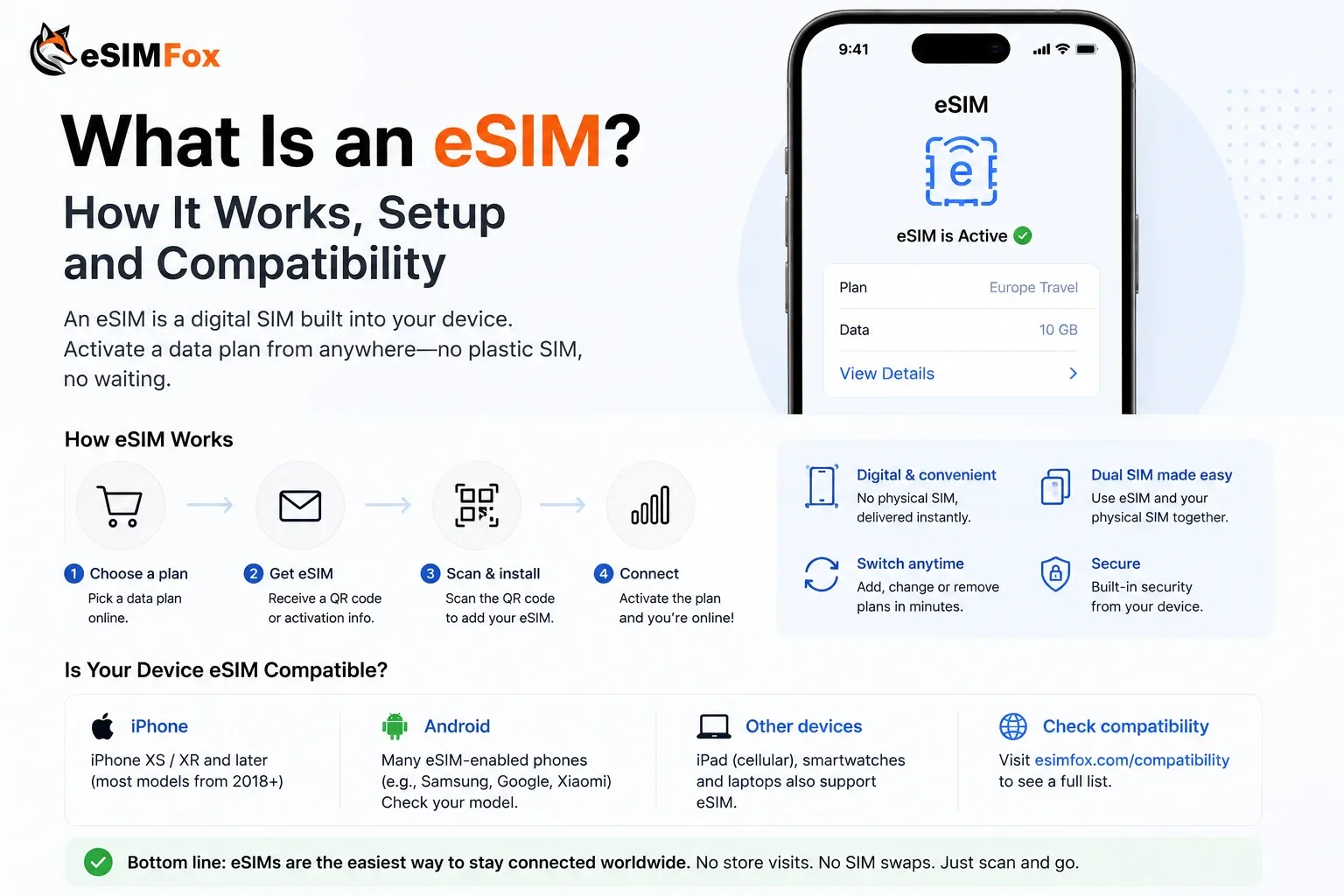
An eSIM is a digital SIM card that installs via QR code. You scan the QR code before flying, and your device connects to local carrier networks when you land. No physical SIM swap, no airport queue, no passport photocopy. You land already connected at JFK, Pearson, or MEX.
A tri-country eSIM (like eSIMFOX's North America plan) covers USA, Canada, and Mexico with one plan. You install it once, and it roams across all three countries. No need to swap plans when you cross the border from Dallas to Monterrey or from Toronto to New York. Hotspot support means you can share your connection with a second device (laptop, tablet, or a friend's phone).
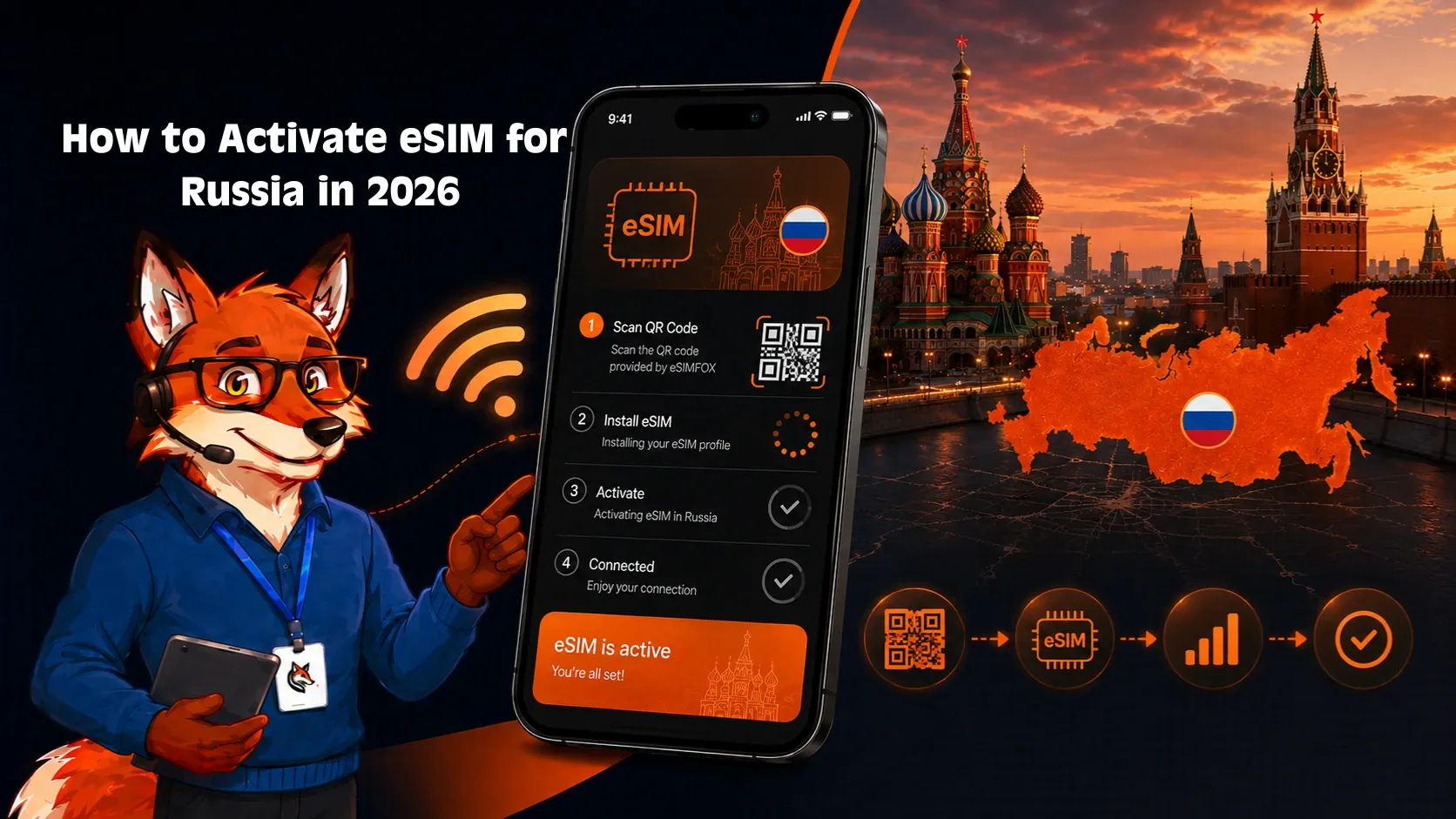
Install your eSIM before flying. Most eSIM providers send the QR code via email within 60 seconds of purchase. Scan the QR code in your device's settings, and the eSIM installs in the background. When you land, your device connects to the local carrier network automatically. No manual APN setup, no carrier selection, no troubleshooting.
Current eSIMFOX plans for North America
Buy a North America eSIM from €3.99
10% off
Exclusive reader bonus
Get an extra 10% off your first eSIMFOX eSIM as a thanks for reading.
NORTHAMERICA10New customers only. One use per account. Subject to change.
Frequently asked questions about World Cup 2026 host cities
Related World Cup 2026 guides
For more World Cup 2026 planning, see the full guide to the best eSIM for FIFA World Cup 2026, which covers connectivity across all 16 host cities, data usage estimates for match days, and troubleshooting tips. The World Cup 2026 schedule guide breaks down all 104 matches by date, venue, and group stage.
Best eSIM for FIFA World Cup 2026: plans, prices, and connectivity tips for all 16 host cities.
Frequently Asked Questions
How many host cities are there for the 2026 World Cup?
Which city is hosting the 2026 World Cup final?
Which country has the most host cities at the 2026 World Cup?
Is Estadio Azteca (Estadio Banorte) hosting the 2026 World Cup?
Will every host city have knockout matches?
Will all host cities have matches at the same time?
What fan zones can you visit in World Cup 2026 host cities?
Which cities in Canada will host the 2026 World Cup?
What is the biggest 2026 World Cup stadium?
Will stadium WiFi work during World Cup matches?
Do I need a different SIM card for each World Cup host country?
What's the best eSIM for traveling between World Cup host cities?
Stay connected on your next trip
Browse eSIM plans for 200+ destinations and activate in 60 seconds.